
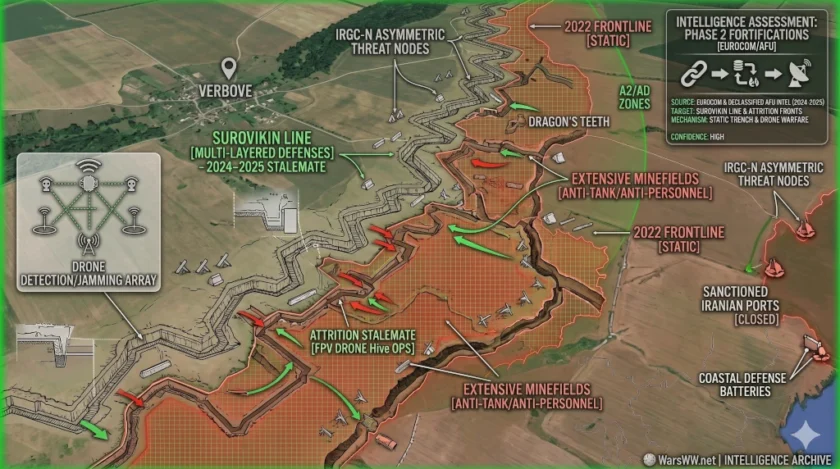
Phase 2 is where the “speed” of Phase 1 died and was replaced by the “weight” of static, industrial-scale attrition. This is the era of the Surovikin Line, the Battle of Avdiivka, and the total Drone Revolution.
The War of Fortifications (2024–2025)
The Strategic Objective: Defensive Consolidation and Industrial Attrition. Following the Ukrainian successes in late 2022, the Russian command shifted to a “Maginot Line” strategy. This phase saw the creation of the most extensive defensive fortifications in Europe since 1945, turning the conflict into a grueling stalemate.
I. The Surovikin Line & The 2024 Counter-Offensive
- The “Iron Belt”: Named after Gen. Sergey Surovikin, Russia constructed a triple-layered system of trenches, anti-tank “Dragon’s Teeth,” and the world’s densest minefields (up to 5 mines per square meter in some sectors).
- The Stalemate: Ukraine’s 2024 summer offensive struggled to achieve a strategic breakthrough. While the AFU reached the first line of defenses at Robotyne and Verbove, the sheer density of Russian mines and the arrival of “KA-52” attack helicopters prevented the maneuver warfare of Phase 1.
“The Russian military’s reliance on fixed fortifications in Phase 2 mirrors a global shift toward ‘zonal control’ also seen in Southeast Asia. For instance, the [SCEF Alliance Map in Myanmar] illustrates how resistance forces are similarly forced to coordinate across vast, contested territories to bypass fixed junta strongpoints.” [SCEF Alliance Map in Myanmar]
II. The Battle of Avdiivka & The Shift in Initiative
- The 4-Month Siege: From October 2023 to February 17, 2024, Russia launched a massive pincer movement to seize Avdiivka, a key Ukrainian stronghold.
- The Result: The fall of Avdiivka marked Russia’s largest gain since Bakhmut. It allowed Russian forces to retake the theater-wide initiative throughout 2024, pushing the frontline slowly westward toward the “Fortress Belt” of Pokrovsk and Chasiv Yar.
“The logistical bottlenecks seen during the siege of Avdiivka represent a broader 2026 trend. As documented in our [Myanmar Conflict Spotlight], the disruption of supply lines has become the primary goal for asymmetrical forces worldwide, from the Donbas to the Sagaing Region.”
III. The Drone Hive & Electronic Warfare (EW)
- The 1,000-Sniper Sky: By 2025, the “Drone Revolution” reached its peak. FPV (First-Person View) drones became the primary weapon of attrition, making the movement of armored vehicles nearly impossible during daylight hours.
- Innovation: Ukraine created the world’s first Unmanned Systems Forces (2024). In response, Russia scaled production to 2 million drones annually by 2025, leading to a perpetual “electronic duel” as both sides deployed massive GPS-jamming and spoofing arrays across the entire 1,000km frontline.
IV. Strategic Reorganization (Late 2025)
- The Corps Reform: To survive the stalemate, Commander-in-Chief Oleksandr Syrskyi initiated a massive overhaul. Ukraine transitioned from a temporary “Brigade” structure to 18 Standardized Army Corps.
- Manpower: This phase was defined by a desperate search for personnel. Ukraine lowered its mobilization age and overhauled recruitment offices to combat the “recruitment gap” that threatened to collapse the line by the end of 2025.
Further reading: “Static Defenses.” Both theaters in 2026 are using “physical barriers” (trenches in Ukraine, floating barriers at Scarborough Shoal) to force a stalemate. South China Sea