
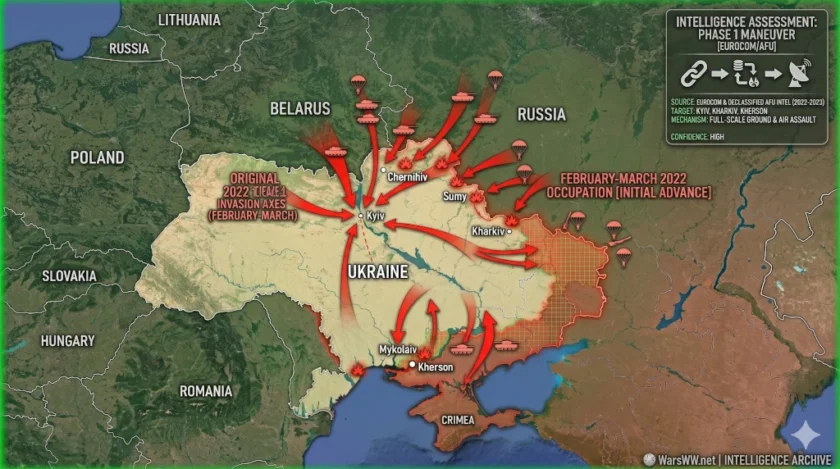
Phase 1: The War of Maneuver (February 2022 – Early 2023)
The Strategic Objective: Rapid Decapitation and Regime Change. The war began on February 24, 2022, with a multi-axis invasion designed to overwhelm Ukraine’s defenses in a matter of days. Russia launched strikes from Belarus (North), Russia (East), and Crimea (South), aiming for a “lightning victory” in Kyiv.
I. The Battle for the Capital (Feb – April 2022)
- The Hostomel Turning Point: Russian paratroopers seized the Antonov Airport (Hostomel) in the first hours, intending to create an airbridge for elite forces. The AFU’s successful counter-attack and the destruction of the runway forced the Russian “40km convoy” into a logistical nightmare.
- The Victory in the North: By April 2, 2022, the “Miracle on the Irpin” was complete. Unable to secure Kyiv or Chernihiv, Russian forces conducted a chaotic retreat, leaving behind evidence of war crimes in Bucha and Irpin that solidified international support for Ukraine.
II. The Siege of the South & Mariupol
- The Fall of Kherson: Unlike the North, the South saw rapid Russian gains. Kherson fell on March 2, 2022—the only regional capital Russia would successfully hold for a significant period.
- The Azovstal Stand: The port city of Mariupol was encircled by early March. The defenders at the Azovstal Steelworks held out until May 20, 2022, pinning down thousands of Russian troops and becoming a global symbol of resistance.
III. The Great Liberations (Late 2022)
By late summer, the war of maneuver shifted in Ukraine’s favor through two masterstroke counter-offensives:
- The Kharkiv Blitz (Sept 2022): In a stunning collapse of the Russian flank, Ukraine reclaimed over 12,000 sq km in days, liberating Izium and Kupiansk. (see “Tatical Deep Dive” below)
- The Liberation of Kherson (Nov 2022): Methodical strikes on Dnieper River bridges forced a Russian withdrawal from the right bank, culminating in the liberation of Kherson city on November 11, 2022.
Tactical Deep-Dive: The Kharkiv Blitz
The Art of the Feint: How Kyiv Out-Thought the Kremlin
The Core Concept: Strategic Misdirection (The “Kherson-Kharkiv” Pivot) For two months, Ukraine’s Southern Command publicized a massive, looming offensive to retake Kherson. Kyiv even utilized mainstream media and “leaked” intelligence to convince the Kremlin that the south was the only priority. Russia bit, shifting five elite brigades and heavy equipment from the Kharkiv region down to the Kherson front.
Intelligence Note: Phase 1 proved that Russia’s Soviet-style logistical “pincer” movements were vulnerable to modern NLAW/Javelin-equipped infantry and decentralized command structures. This failure led directly to the static “Surovikin” fortification phase of 2024.
I. The “Shaping” Phase
- The Info-War: Ukraine rooted out local informants in the Kharkiv region weeks before the attack to ensure total radio silence.
- The Intelligence Gap: By late August, the Russian lines in Kharkiv were manned by “underequipped and exhausted” personnel, including forcibly mobilized units and the Rosgvardia (National Guard), who lacked the heavy weaponry to stop a combined-arms breakthrough.
II. The Execution [Sept 6 – Sept 12, 2022]
- The Breakthrough: Ukrainian forces didn’t just attack; they bypassed Russian strongpoints. Utilizing highly mobile units (including Humvees and light armored vehicles), they punched through the line at Balakliya.
- The Logistical Collapse: Within 72 hours, the AFU reached Kupiansk—the critical rail hub for the entire Russian northern front. This effectively cut the “artery” for thousands of Russian troops.
- The Route: The Russian retreat turned into a “panic-stricken flight.” Russia abandoned hundreds of pieces of intact heavy equipment, including T-80 tanks and Msta-S howitzers, making Ukraine (briefly) the largest “supplier” of tanks to its own army.
III. The Aftermath & 2026 Perspective
- Strategic Gain: Ukraine reclaimed 3,000 square kilometers in just six days—more territory than Russia had captured in the previous five months.
- The Command Shift: This defeat led to the appointment of Gen. Sergey Surovikin and the subsequent decision to build the massive “Surovikin Line” (Phase 2), as Russia realized it could no longer win a war of maneuver against a faster, more agile AFU.
To compare “asymmetrical deception”—where small, agile units overcome a larger, rigid force: see Mexican Drug Wars