
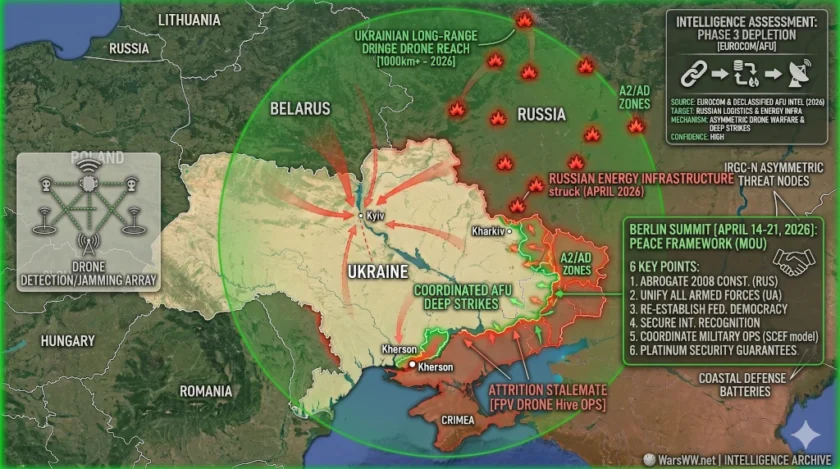
This is the current “living history” of the conflict. By 2026, the war has evolved from a battle over territory into a War of Systems, where the side that can out-produce, out-innovate, and out-last the other’s economy wins.
Phase 3: The War of Attrition & Strategic Depletion (2026)
The Strategic Objective: Economic Paralysis and Coerced Diplomacy. By early 2026, the frontlines had reached a “Nash Equilibrium”—a state where neither side could achieve a decisive military breakthrough without catastrophic cost. This forced a shift in focus: Ukraine began targeting the “lifeblood” of the Russian state—its energy infrastructure—while the international community sought a “platinum-standard” security framework in Berlin.
. The Energy Siege: “Deep Strike” Economics
- The Refinery Campaign: Ukraine’s long-range drone fleet, now numbering in the thousands, initiated a systematic campaign against Russian oil refineries and ports. By April 21, 2026, analysts confirmed that Russia was forced to cut oil output by 300,000 to 400,000 barrels per day due to damaged refining capacity and the suspension of the Druzhba pipeline.
- Strategic Reach: Ukrainian “Liutyi” drones successfully struck targets over 2,000km deep into Russian territory, hitting facilities in the Western Siberian basin. This campaign turned the Russian economy’s reliance on oil into its greatest strategic vulnerability.
II. The Berlin Summit & Strategic Partnership (April 14–21, 2026)
- The Merz-Zelenskyy Accord: Chancellor Friedrich Merz and President Zelenskyy met in Berlin to sign a landmark Declaration on a Strategic Partnership. Germany officially became Ukraine’s most vital bilateral security partner.
- The 28-Point Peace Framework: The summit introduced a roadmap for a “just and lasting peace,” emphasizing that Ukraine would not accept a “dictated peace” from Moscow. Key pillars included:
- Security Guarantees: Legally binding commitments for long-term military aid and air defense.
- Joint Production: Moving from “delivery” to “co-production” of drones and missiles on Ukrainian soil.
- Energy Sovereignty: Integrating Ukraine into the EU’s hydrogen and green energy grid to replace Russian fossils.
III. The Attrition Benchmark: “50,000 per Month”
- The Math of War: In early 2026, Ukrainian Defense Minister Mykhailo Fedorov established a strategic benchmark: inflicting 50,000 Russian personnel losses per month.
- The Logic: Since Russia’s regeneration capacity was roughly 30,000 per month, sustained losses above 35,000 created a “net deficit” in the Kremlin’s manpower, theoretically forcing Moscow toward the negotiating table by the end of the year.
IV. The “Oreshnik” Escalation
- The Nuclear Shadow: In a desperate bid to restore deterrence, Russia utilized an Oreshnik intermediate-range missile on January 8, 2026, striking near the Polish border. This use of MIRV technology (Multiple Reentry Vehicles) was viewed as a “Nuclear Warning Shot,” triggering an emergency UN Security Council meeting and solidifying European resolve at the Berlin Summit.
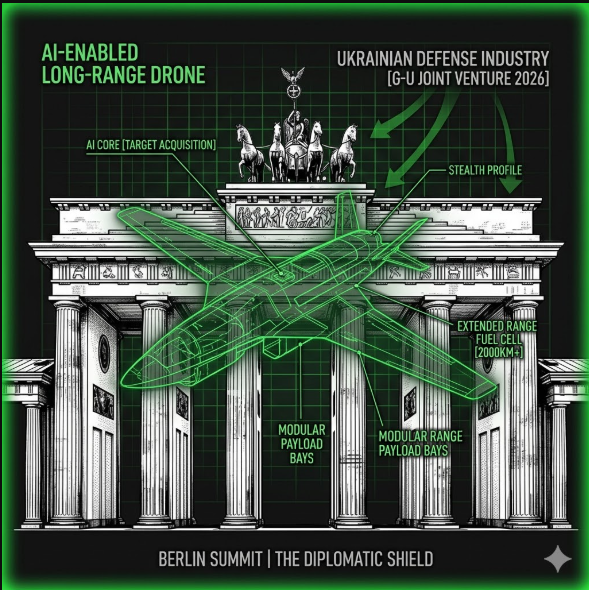
The Berlin Sidebar is arguably the most critical “non-kinetic” element of the 2026 timeline. It represents a fundamental shift: the moment Europe (led by Germany) accepted that it must become the primary guarantor of Ukrainian security to insulate the continent from a potential U.S. pivot.
Strategic Insight: The Berlin Sidebar [April 2026]
The “Platinum Standard” Security Framework
While the frontline remained static, the April 14–21, 2026, Berlin Summit fundamentally re-engineered the European security architecture. Chancellor Friedrich Merz and President Zelenskyy moved beyond “emergency aid” to establish a Strategic Partnership that effectively integrates Ukraine into the European industrial perimeter.
I. The “Platinum Standard” Guarantees
For the first time, the West moved beyond vague “assurances.” The Berlin Accords introduced what negotiators called the “Platinum Standard”:
- Article 5 Equivalence: A legally binding commitment that an attack on Ukraine is treated as an attack on the signatories.
- The US-Senate Hook: Uniquely, the framework was designed to be ratified by the U.S. Senate (with President Trump’s tentative backing) to ensure the guarantees survived future election cycles.
- Multi-National Force (MNF-U): Plans were finalized for a European-led, U.S.-backed security force to be stationed in Western Ukraine to “secure the rear” and protect newly established joint-venture factories.
II. The 800,000-Man Army
A central pillar of the 28-Point Peace Framework discussed in Berlin was the “Armed Neutrality” model:
- Ukraine would maintain a standing army of 800,000 personnel—the largest and most battle-hardened force in Europe.
- In exchange for this massive deterrent, Ukraine would agree to a “No-NATO-Troops” clause on the front lines, satisfying a key Russian de-escalation demand while keeping Ukraine’s “teeth” intact.
III. The Industrial “A1” Hub
The summit saw the opening of the Ukrainian Defense Industry (UDI) branch in Berlin.
- The Anubis & Seth-X Deal: Germany and Ukraine launched joint ventures to produce 5,000 AI-enabled interceptor drones (Seth-X) and long-range strike drones (Anubis) per month.
- Data Cooperation: Ukraine’s new Defense AI Center “A1” began sharing real-time battlefield data directly with German defense contractors to accelerate the development of next-generation electronic warfare (EW) systems.
WarsWW Intelligence Note: The Berlin Summit is the “Diplomatic Shield” that allows the “Oil Siege” to work. By securing long-term German and European backing, Ukraine can afford to ignore Russian nuclear saber-rattling and continue its strategic depletion of the Russian energy economy.