
Latvia Ukraine Sign Drone Deal Defense Cooperation NB8 Summit 2026
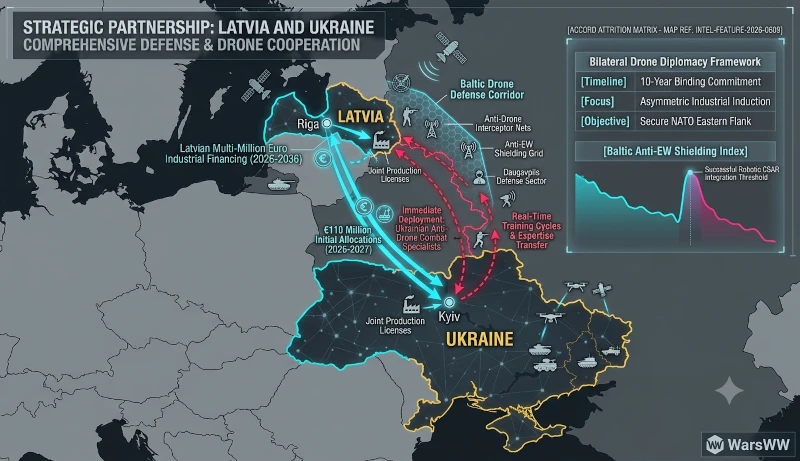
WarsWW Strategic Feature: Baltic Drone Diplomacy—Latvia and Ukraine Codify Historic 10-Year Defense Accord
Strategic Status: ASYMMETRIC INDUSTRIAL INDUCTION / SKY SHIELD INTEGRATION / TRANS-BALTIC DEFENSE LINE
Theater Focus: Tallinn (NB8 Summit) / Riga / Kyiv
The technological and tactical lessons of Europe’s high-intensity drone wars have been institutionalized into a permanent, decade-long security alliance. On June 9, 2026, on the sidelines of the Nordic-Baltic Eight (NB8) Summit in Tallinn, Estonia, Ukrainian President Volodymyr Zelenskyy and the newly appointed Latvian Prime Minister Andris Kulbergs formally executed a comprehensive defense cooperation agreement widely designated as the “Drone Deal.”
Marking the sixth bilateral agreement secured under this specialized asymmetric format, the pact codifies a deep, mutual exchange: Riga provides stable, multi-million euro industrial financing, while Kyiv directly transfers raw combat expertise to secure NATO’s vulnerable eastern flank.
I. The Strategic Blueprint: Funding Eastern European Air Canopy Readiness
The bilateral accord moves beyond temporary military aid packages, establishing a rigid, long-term framework for technology transfer and infrastructure development.
I. The Strategic Blueprint: Funding Eastern European Air Canopy Readiness
The bilateral accord moves beyond temporary military aid packages, establishing a rigid, long-term framework for technology transfer and infrastructure development.
| Temporal Coordinates | Finacial and Material Allocations | Core Operational Objectives |
| Years 1 & 2 (2026–2027) | €110 Million Dedicated Injection | Accelerating joint production lines and testing border tracking nets |
| Full Agreement Lifecycle | 10-Year Binding Committment | Deep integration of intelligence assets and post-war reconstruction logistics |
To ensure rapid scaling, the Latvian Cabinet of Ministers cleared an initial financial mandate, with Latvia intending to allocate approximately €110 million over the first two years to fulfill the agreement’s frontline parameters.
This capital pool will be channeled directly into co-production loops, technology transfers, and accelerating the introduction of Ukrainian frontline experience into the Latvian National Armed Forces.
II. Reverse Technology Transfer: Kyiv Exports Unmanned Expertise
The defining element of the June 2026 Drone Deal is its reciprocal nature. While typical defense pacts feature Western states exporting hardware to Ukraine, this framework leverages Ukraine’s status as the global epicenter of unmanned warfare innovation.
The Baltic-Ukraine Tech Integration Loop
| Phase 1: Capital Inflow | Phase 2: Knowledge Export | Phase 3: Theater Stabilization |
| Latvian Industrial Funding | Ukrainian Combat Know-How | Hardened NATO Airspace |
| • €110 Million Early Investment Injection | • Immediate Expert Counter-UAV Deployment | • Advanced Anti-EW Deflection Canopy |
| • Scaled Production Facilities Operational | • Real-Time Combat Training Cycles | • Integrated Baltic Border Security Shield |
- The Anti-Drone Special Forces Deployment: Prime Minister Andris Kulbergs confirmed that the agreement establishes the immediate deployment of Ukrainian anti-drone combat specialists to Latvia. These veteran operators are tasked with training Latvian forces in real-world countermeasures, electronic warfare evasion, and low-altitude interception.
- The Electronic Warfare Shield: The operational training is highly time-sensitive for Riga. The Baltic states have faced a surge in airspace violations by rogue drones, driven by intense Russian electronic warfare interference along the eastern borders. Proclaiming the necessity of the deal, Kulbergs noted that “nobody knows how to protect skies better than Ukraine,” framing the acquisition of Ukrainian know-how as a critical national security priority.
- Sovereign Supply Line Interdiction: Beyond the technical parameters, the two leaders utilized the summit to align their economic defenses, coordinating strategies to clamp down on Russia’s shadow fleet actively using Baltic Sea shipping lanes to sneak out energy resources and fund sanctions-bypassing military supply lines.
III. Featured Visual Intelligence Archive [REF: INTEL-MAP-2026-0609-BALTIC]
Figure 1: Strategic visual map charting the cross-border drone defense corridors, tracking the immediate flow of Ukrainian tactical anti-drone units into Latvian training grounds alongside the industrial investment lines connecting Riga and Kyiv. (top of page)
IV. Indicators to Watch
- [INDUSTRIAL VELOCITY] Joint Production Licensing Cadence: Track the issuance of export and manufacturing permits by the Latvian Ministry of Defence. Following the formalization of the deal, watch for how quickly Ukrainian drone platforms—particularly AI-guided loitering models—receive localized manufacturing codes for assembly within Latvian military-industrial complexes.
- [BORDER SEGMENTATION] Baltic Counter-EW Deployment: Monitor GPS and signal telemetry reports along Latvia’s eastern frontier with Russia and Belarus. Watch for the installation of new, Ukrainian-designed passive electronic radar nodes and anti-drone interceptor nets designed to harden NATO airspace against GPS-jamming waves.
WarsWW Editorial Intelligence Note [REF: FEATURE-BALTIC-DRONE-2026]
The signing of the Latvia-Ukraine Drone Deal marks a fundamental shift in NATO-Transatlantic Security Integration. For years, international defense frameworks assumed that security flowed exclusively from Western industrial centers toward peripheral conflict zones. This agreement effectively upends that legacy model. By formalizing a pact where a frontline NATO state explicitly relies on Ukrainian combat specialists and battlefield technology to safeguard its sovereign airspace, Riga is acknowledging that peace-time military doctrines are entirely obsolete. As Russia continues to pressure border airspaces with electronic warfare masking and border-probing drone vectors, this trans-European industrial alliance provides a highly practical roadmap for survival. It pairs Baltic capital with blood-bought Ukrainian innovation to construct an adaptive, automated defense canopy capable of resisting modern asymmetric warfare.