Sudan Drone Strikes Infrastructure Carnage El Obeid Um Baru 2026
WarsWW Strategic Feature: The Darfur and Kordofan Infrastructure Carnage—Foreign Drones Modernize Sudan’s Civil War
Strategic Status: SYSTEMIC INFRASTRUCTURE LIQUIDATION / ASYMMETRIC FLANKING MANEUVERS / URBAN ENERGY INTERDICTION
Theater Focus: El Obeid (North Kordofan) / Um Baru (North Darfur) / Geneva (UNHRC)
The war in Sudan has entered a lethal phase of automated attrition, shifting from conventional ground battles to a highly coordinated, foreign-backed aerial assault against vital public utilities. In a series of intensive drone bombardments over the second week of June 2026, paramilitary and military factions targeted critical water plants, fuel hubs, and civilian logistics corridors spanning the Kordofan and Darfur regions.
The escalated use of unmanned aerial vehicles (UAVs) has systematically dismantled the remaining civil infrastructure in western and central Sudan, effectively trapping millions of trapped civilians inside rapidly deteriorating urban centers.
I. The Kordofan Energy Interdiction: Five Days of Sustained Drone Blitzo
The strategic hub of El Obeid—the capital of North Kordofan State and a vital operational base for the Sudanese Armed Forces (SAF)—faced its most destructive aerial campaign since the war began.
Operational Impact Matrix: Greater Kordofan and Darfur
| Tactical Target Vector | Location | Operational Consequence | Strategic Systemic Fallout |
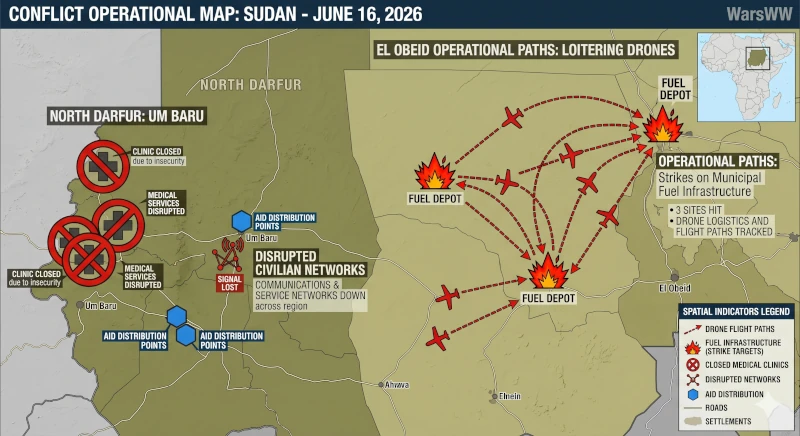
| Airport District Service Station & Bulk Fuel Farms | El Obeid, North Kordofan | Five distinct fuel facilities destroyed or set ablaze by loitering munition waves | Regional retail energy supply completely severed; emergency civilian transit halted |
| Primary Healthcare Unit & Local Marketplace | Um Baru, North Darfur | Facilities looted and struck; medical operations indefinitely suspended | Total collapse of local humanitarian distribution network |
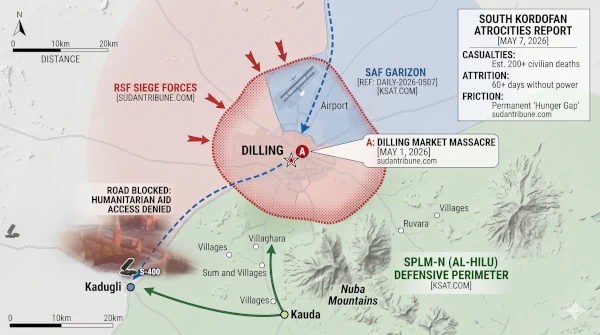
| Urban Logistics Vehicle Transit | Dilling, South Kordofan | Vehicle destroyed by a targeted precision drone payload | Humanitarian supply lines isolated; aid corridors compromised |
Operating an aggressive aerial envelopment, paramilitary Rapid Support Forces (RSF) drones struck urban areas in El Obeid for five consecutive days. The loitering munition waves directly targeted key service stations and municipal bulk storage assets, striking a major fuel station in the Airport district and a nearby fuel storage tank.
Eyewitnesses in the eastern neighborhoods recorded multiple overlapping fires as at least five distinct fuel facilities were completely destroyed or set ablaze. The parallel strikes killed nine civilians, including a dedicated volunteer with the Sudanese Red Crescent Society, while severely compromising the city’s broader water and electricity grids.
II. The Darfur Border Purge: The Destruction of the Um Baru Node
Simultaneously, the aerial violence expanded northwest into North Darfur State, targeting remote logistics corridors near the Chadian border that are vital for sustaining displaced populations.
| Stage 1: Foreign Inflow | Stage 2: Utility Targeting | Stage 3: Systemic Collapse |
| Foreign Drone Supply | Precision Utility Strike | Civic Grid Collapse |
| • Steady trafficking of advanced tactical UAV platforms • Integration of foreign EW-guided piloting arrays | • Precise destruction of municipal fuel storage tanks • Fragmentation of critical regional water pumping networks | • Total suspension of essential medical care vectors • Sharp spikes in unmanaged regional displacement surges |
- The Healthcare System Liquidation: In North Darfur State, a devastating aerial assault hit a prominent village within the locality of Um Baru, killing at least eight civilians and wounding dozens of others. The local marketplace was looted amid the chaos, and the village’s primary healthcare unit was forced to indefinitely suspend all medical operations. This leaves tens of thousands of displaced persons completely cut off from basic trauma care.
- The Southern Kordofan Transit Attacks: The aerial containment loop further expanded into South Kordofan State. UN Spokesperson Stéphane Dujarric verified that a separate precision drone strike targeted a commercial vehicle in the town of Dilling, killing two civilians. The attack occurred as UNICEF managed to deploy an eight-truck convoy carrying vital health and water supplies to support 39,000 isolated residents in Dilling and Kadugli.
III. The International Indictment: The 1,000-Casualty Threshold
The expanding reliance on explosive-laden drones has transformed Sudan’s conflict into one of the world’s most acute humanitarian disasters. Addressing the UN Human Rights Council in Geneva, UN High Commissioner for Human Rights Volker Türk announced that drone strikes have killed over 1,000 civilians in Sudan during the first five months of 2026 alone.
Türk strongly condemned the warring factions for increasing their brutality from the skies by utilizing drones supplied by foreign backers to target civilian infrastructure, including hospitals, dams, and busy marketplaces. Echoing the UN assessment, U.K. Minister for Africa Jenny Chapman labeled the aerial targeting of aid workers and vital utilities as deplorable, urging international monitors to carefully preserve evidence for future war crimes prosecutions.
IV. Indicators to Watch
- [LOGISTICS FLOW] Intercommunal Security Halts: Monitor aid truck coordinates through Central Darfur. Following the wave of drone attacks, track whether growing intercommunal tensions delay vital food assistance for 31,000 people in the locality of Mukjar, signaling a total breakdown of internal humanitarian movement.
- [MILITARY MANEUVER] The Omdurman Export Highway Corridor: Watch the deployment of RSF units stationed along the northern export highway. With the paramilitary group leveraging positions in Bara to cut off eastern land routes, track whether the SAF attempts to mount a mechanized counter-offensive to lift the siege on El Obeid’s fuel network.
WarsWW Intelligence Note [REF: FEATURE-SUDAN-DRONE-2026]
The systematic destruction of Kordofan’s energy infrastructure and Darfur’s healthcare assets exposes a brutal evolution in Modern Asymmetric Siege Warfare. Warring factions in Sudan are no longer prioritizing the capture of territory; instead, they are utilizing foreign-engineered loitering munitions to make major population centers completely uninhabitable. By targeting critical fuel facilities, water networks, and small village clinics, military forces can force the mass displacement of entire civilian populations without launching risky, high-casualty ground assaults against entrenched defenses.
This approach marks a dangerous shift in international conflict dynamics. As international attention remains focused on the fragile peace negotiations in the Middle East and deep-theater strikes in Eastern Europe, foreign arms networks are using Sudan as an unmonitored testing ground for automated warfare. This development proves that when cheap drone technology flows unchecked into a fractured state, civilian infrastructure becomes the primary target, turning the fundamental elements of daily survival into immediate casualties of war.