Ukraine Drones Strike Moscow Refinery Netanyahu Defies US Iran Ceasefire Deal
WarsWW Daily Brief | June 16, 2026
Intelligence Status: REFINERY LAYER BREACHED / TREATY ACCORD RESISTANCE / MULTI-THEATER AIR ESCALATION
Global Security Index: 9.94/10 (High Asymmetric Volatility)
I. Eastern Europe: The Moscow Oil Refinery Inferno and the Krasnodar Depot Saturation
The long-range air war has struck directly into the economic heart of the Russian capital. In a massive, synchronized overnight offensive, Ukrainian deep-strike drone assets penetrated heavily layered metropolitan air defenses, triggering a catastrophic fire at Russia’s primary regional energy infrastructure node.
The Capital- littoral Energy Interdiction Matrix
| Operational Vector Node | Primary Asset Targeted | Direct Strategic Consequence |
| Kapotnya District, Moscow | Moscow Oil Refinery Complex | Primary processing facilities ignited; 50% capital fuel supply threatened |
| Poltavskaya, Krasnodar | Regional Fuel Storage Depot | Fuel tank farm compromised; secondary regional gasoline deficits worsen |
| Multi-Region Envelope | Domestic Air Defense Arrays | 172 intercept actions recorded; localized airspace restrictions enforced |
- The Kapotnya Strategic Interdiction: Shaking the Russian capital early Tuesday morning, a high-volume wave of Ukrainian long-range strike drones successfully penetrated the metropolitan security canopy to strike the Moscow Oil Refinery in the Kapotnya district. Moscow Mayor Sergei Sobyanin claimed that air defense crews shot down 35 drones targeting the capital region, but verified terminal breaches sparked a massive industrial fire at the facility. The strategic fallout is severe; the refinery normally handles and supplies nearly half of all petroleum fuel utilized by the city of Moscow.
- The Poltavskaya Depot Ignition: Simultaneously, a parallel drone wave targeted logistical supply nodes 385 kilometers behind the front line. Falling debris and direct impacts ignited an oil depot in the village of Poltavskaya, Krasnodar Krai, requiring 32 emergency personnel to control the blaze. The targeted facility functions as a distribution hub for Lukoil gas stations, threatening to worsen an acute gasoline shortage sweeping across the Krasnodar region and annexed Crimea, where local fuel stations have completely run out of retail fuel reserves.
- The G7 Diplomatic Backdrop: The deep-theater strike was executed as Ukrainian President Volodymyr Zelenskyy joined Western leaders for closed-door security meetings at the G7 summit in Évian-les-Bains, France. The kinetic leverage coincided with a major diplomatic milestone, occurring just one day after Ukraine officially commenced formal negotiations in Luxembourg to join the European Union.
II. Middle East: The Secret US-Iran Accord and the Israeli Sovereignty Veto
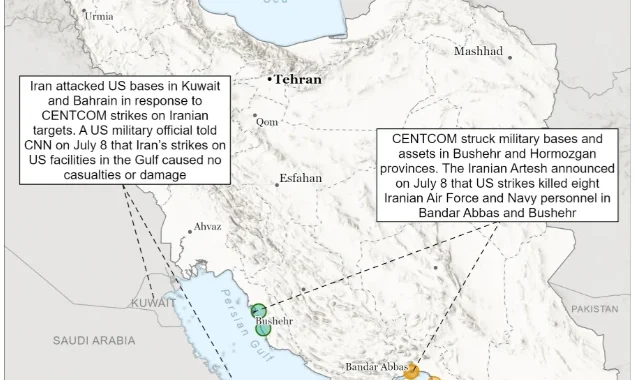
The preliminary electronic signing of the U.S.-Iran Memorandum of Understanding (MoU) has sparked an acute geopolitical crisis, with regional allies openly revolting against the White House’s secret diplomatic text.
| Temporal Axis | Phase 1: Electronic Signing | Phase 2: Jerusalem Revolt | Phase 3: Reopening Target |
| Operational Coordinate | Sunday: Preliminary Execution | Monday: Regional Defiance | Friday: Chokepoint Deadline |
| Key Strategic Event | • Secret 2-page text executed • U.S. lifts naval blockade | • Netanyahu rejects pullback • Ben-Gvir declares independence | • Trump sets Hormuz deadline • Shipping firms freeze transit |
- The Secret Document Disclosure: Vice President J.D. Vance confirmed that the preliminary ceasefire agreement signed between Washington and Tehran is a highly general, two-page memorandum of understanding, with core technical details yet to be settled. While President Donald Trump declared the naval blockade lifted and stated that the Strait of Hormuz would be completely open by Friday, international maritime carriers like Mitsui O.S.K. Lines announced they will not resume transits until safety is sufficiently confirmed, noting that U.S. forces are still actively hunting for Iranian sea mines.
- The Jerusalem Defiance: The deal faces an immediate internal veto from Israel. Breaking his silence on the secret pact, Israeli Prime Minister Benjamin Netanyahu explicitly stated that the deal was Trump’s decision and vowed that Israeli forces will remain in southern Lebanon “as long as necessary,” directly defying the regional armistice conditions. National Security Minister Itamar Ben-Gvir escalated the rhetoric, posting on social media that “Trump’s agreement does not bind us” because Israel is an independent, sovereign country.
- The Counter-Ultimatum from Tehran: In response to the Israeli statements, Iranian Foreign Minister Abbas Araghchi delivered a blunt counter-ultimatum, asserting that the end of the war in Lebanon is an inseparable part of a complete ceasefire. Araghchi warned that without a full withdrawal of Israeli troops from newly occupied territories, the peace agreement cannot fully take effect. Meanwhile, U.S. intelligence agencies remain deeply skeptical, with CIA Director John Ratcliffe warning Trump that Iran’s private discussions regarding nuclear concessions contradict their public commitments.
III. East Africa: The Sudanese Drone Warfare Surge
A horrifying milestone has been crossed in the expanding Sudanese civil war, driven by a dramatic influx of foreign-engineered unmanned aerial platforms.
- The 1,000 Civilian Casualty Threshold: Speaking before the UN Human Rights Council in Geneva, UN High Commissioner for Human Rights Volker Türk revealed that drone strikes have killed more than 1,000 civilians in Sudan during the first five months of 2026. Türk warned that the conflict has expanded dramatically due to an increasing reliance on unmanned aerial vehicles by both warring factions.
- The Darfur and Kordofan Infrastructure Carnage: UN field monitors reported that intensive drone bombardments over the past week killed nine civilians in El Obeid, damaging local water and fuel stations. A separate drone strike in the North Darfur village of Um Baru killed eight civilians, forcing the local market to close and halting humanitarian aid operations intended for tens of thousands of displaced persons.
IV. Indicators to Watch
- [ENERGY FUTURES] Moscow Capital Fuel Rationing: Monitor domestic Russian fuel retail indexes. Following the severe structural damage inflicted on the Kapotnya refinery complex, watch for the Kremlin to enforce immediate fuel distribution caps across the Moscow oblast to prevent localized panic buying and pump shortages.
- [COALITION SEGMENTATION] The Friday Hormuz Shipping Test: Track maritime transit telemetry inside the Persian Gulf. With Trump setting a Friday deadline for the total reopening of the Strait of Hormuz and commercial shipping firms refusing to move until safety is guaranteed, watch whether G7 navies launch a joint mine-clearing mission to force open the chokepoint.
WarsWW Intelligence Note [REF: DAILY-2026-0616]
The global security landscape is facing a crisis of Sovereign Enforcement De-synchronization. President Trump’s rapid push to implement a generalized, two-page MoU with Tehran reveals a desire to achieve a high-profile diplomatic victory and stabilize global energy chokepoints. However, Israel’s explicit refusal to pull back from Lebanon proves that local security priorities will easily bypass superpower mandates.
This diplomatic disconnect is being exploited on the battlefield. By bypassing traditional frontline defenses to strike the primary fuel source of the Russian capital, Ukraine is demonstrating that it can impose severe economic costs on Moscow completely independent of the diplomatic maneuvering taking place at the G7 summit. As asymmetric drone warfare simultaneously destabilizes Eastern Europe and East Africa, the international community’s reliance on traditional, top-down treaties is proving entirely insufficient against highly independent actors determined to achieve absolute leverage on the ground.