US Airstrikes Iran Sirik Water Reservoirs Ukraine Flamingo Missile Cheboksary
WarsWW Daily Brief | June 10, 2026
Intelligence Status: SYSTEMIC REGIONAL ESCALATION / INFRASTRUCTURE CRUSH / BILATERAL CEASEFIRE COLLAPSE / STRATEGIC AIRFRAME RAIDS
Global Security Index: 10.00/10 (Absolute Theater Rupture)
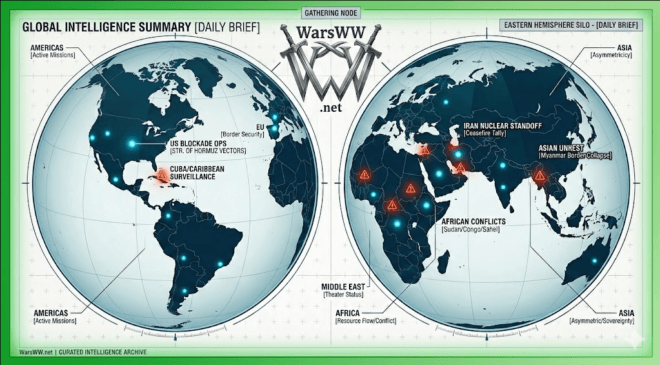
I. Middle East: The Retaliatory Cascade and the Complete Collapse of the Gulf Truce
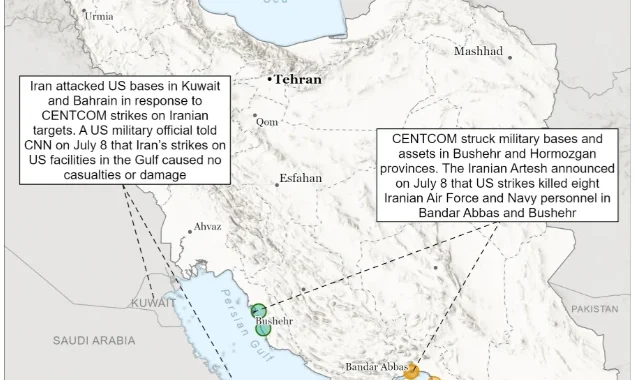
The fragile, Pakistan-mediated temporary ceasefire has dissolved into open, high-intensity conflict. Blaming Tehran for the recent downing of a U.S. Army Apache helicopter, the United States executed heavy overnight air raids on sovereign Iranian soil, triggering widespread ballistic and regional proxy retaliation that has drawn neighboring states directly into the crossfire.
- The Bombing of Sirik and Qeshm: In a major escalation of the regional air war, the United States launched massive overnight airstrikes against targets in Jask, Sirik, and Qeshm Island along the Strait of Hormuz. While the Pentagon asserted the operations exclusively hit IRGC radar and communication grids, Iranian state media confirmed severe damage to civilian infrastructure. The strikes destroyed two major water reservoirs in Sirik, completely cutting off safe drinking water for 20,000 residents amid blistering summer temperatures ranging between 45 and 50 degrees Celsius.
- The Base Intercepts in Jordan, Kuwait, and Bahrain: The IRGC responded instantaneously with coordinated ballistic waves, launching counter-strikes against a U.S. base in Jordan and 21 other coalition targets throughout the Gulf, claiming successful hits on central facilities in Kuwait and Bahrain.
- The Executive Price Ultimatum: In a sharp policy hardening, U.S. President Donald Trump posted an explicit warning via Truth Social, stating that Iran had taken “too long to negotiate a deal that would have been great for them” and would now “pay the price,” claiming the Iranian military framework is completely defeated. In response, Iranian Foreign Ministry Spokesperson Esmail Baqaei stated that the U.S. strikes have forced Tehran to thoroughly reassess its participation in any future diplomatic process.
- The Global Energy Strangulation: The economic fallout of the renewed blockade has severely jarred international markets. Shell CEO Wael Sawan warned that the Strait of Hormuz disruption has removed more than 10% of global oil production from the market, triggering unprecedented logistics chaos and forcing severe fuel rationing across India, Indonesia, Thailand, and Vietnam.
- The Shlomi Drone Intercept: In the Levant theater, the proxy friction remains volatile. The IDF verified that Israeli air defense networks successfully intercepted a suspected Hezbollah drone over southern Lebanon before it could cross into the border community of Shlomi, directly adjacent to active IDF ground operations.
II. Eastern Europe: The Flamingo Missile Debut and the Tri-Region Refinery Blast
The air war over the Russian Federation has escalated dramatically, as Ukrainian forces deployed a highly classified, long-range missile platform to dismantle key drone manufacturing links deep inside sovereign Russian territory.
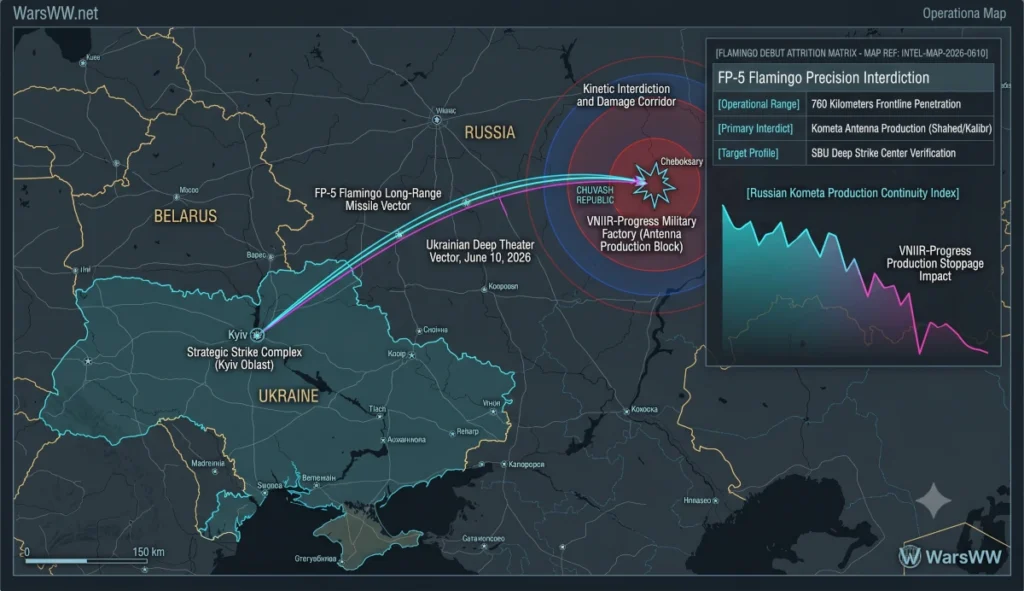
- The Cheboksary Military Plant Interdiction: Ukrainian President Volodymyr Zelenskyy formally confirmed that newly unveiled, long-range Ukrainian FP-5 Flamingo missiles successfully struck the VNIIR-Progress military factory in Cheboksary, located deep within Russia’s Chuvash Republic. The sanctioned facility serves as a primary supplier for the Kremlin’s war effort, manufacturing specialized satellite navigation receivers and Kometa antennas utilized in Shahed-type drones, Kalibr cruise missiles, and guided aerial bombs. Regional Governor Oleg Nikolaev confirmed the arrival caused severe structural fires and left three people injured.
- The Vladimir and Samara Refinery Wave: The missile debut formed the tip of a wider, multi-axis strategic surge. Separate long-range drone waves executed by the Security Service of Ukraine (SBU) successfully struck the Kuibyshev oil refinery in Samara Oblast—located 900 kilometers from the frontline—alongside the Vtorovo and Lobkovo oil pumping facilities in Vladimir Oblast, roughly 700 kilometers deep. Satellite thermal anomalies confirmed significant fires across both infrastructure corridors.
- The West Horizon Intercept: In the maritime attrition theater, the Ukrainian General Staff confirmed a precision drone attack successfully damaged the steering and propulsion mechanisms of the Russian shadow fleet tanker West Horizon in the Black Sea, directly targeting a vessel actively used by Moscow to circumvent international energy sanctions.
- The 326-Vector Defensive Counter-Claims: Attempting to minimize the optical damage of the deep-theater penetrations, the Russian Ministry of Defense asserted its local air defenses neutralized 326 Ukrainian drones across 19 separate regions and occupied Crimea. Notably, the Chuvash Republic was completely omitted from the ministry’s defense ledger.
III. Featured Visual Intelligence Archive [REF: INTEL-MAP-2026-0610]
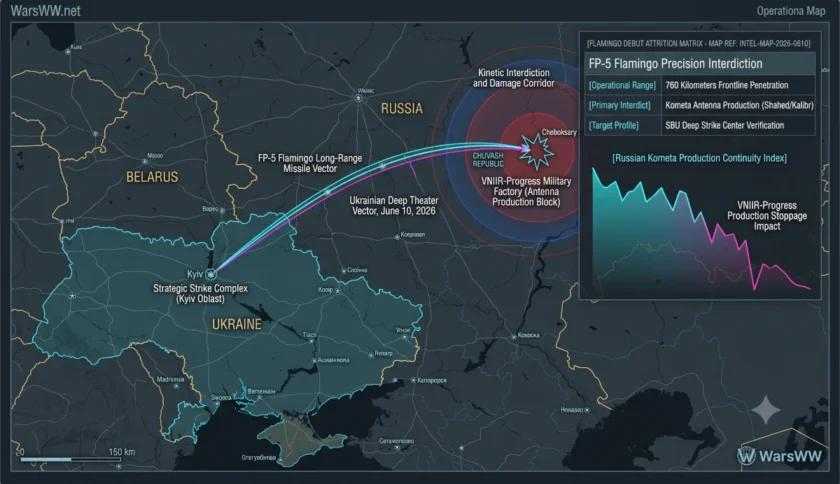
Figure 1: Strategic operational layout detailing the geographical intersection of the U.S. Navy’s retaliatory strikes on the Sirik water infrastructure next to the precise flight envelope of Ukraine’s Flamingo missile strike on the Cheboksary drone component plant, June 10, 2026.
IV. Indicators to Watch
- [LOGISTICS] The Sirik Water Squeeze Protests: Track civil unrest telemetry within Iran’s southern Hormozgan Province. Following the destruction of the primary Bemani and Kouhestak water reservoirs by U.S. forces, monitor whether the sudden loss of drinking water for 20,000 citizens amid 50°C heat triggers localized, anti-regime demonstrations or forces an emergency military redirection of IRGC logistics assets.
- [PROCUREMENT] Flamingo Missile Serial Analysis: Watch open-source intelligence feeds tracking Western Russian airspace. Following the first verified deployment of the FP-5 Flamingo missile platform, analyze debris recovery imagery from Cheboksary to determine if the guidance components rely on advanced Western semiconductors or localized, repurposed drone infrastructure.
WarsWW Intelligence Note [REF: DAILY-2026-0610]
The global conflict model has officially transitioned into a phase of Total Infrastructure Deconstruction. The deliberate targeting of Iran’s water utilities by the United States and Ukraine’s deep-theater missile neutralization of Russia’s Kometa antenna factory prove that both theaters have discarded traditional military-only parameters. By executing strikes that trigger immediate, severe domestic consequences—such as fuel rationing across Asia and critical utility collapses in the Persian Gulf—both coalitions are betting that near-term domestic shock will fracture the adversarial coalition’s resolve before global economic supply chains completely break down.