Navy Sea Drone Rescues Apache Helicopter Crew Strait Of Hormuz Corsair ASV 2026
WarsWW Intelligence Feature: Operation Autonomous Retrieve—Inside the First Sea-Drone Rescue in Military History
Strategic Status: ROBOTIC PERSONNEL RECOVERY / CONTINGENCY RECOVERY LOGISTICS / TECH INTEGRATION BREAKTHROUGH
Theater Focus: Strait of Hormuz / Coast of Oman
On the evening of June 8, 2026, an armed conflict that had been defined by high-altitude drone duels and maritime blockades crossed an unprecedented milestone in automated tactical response. Following a mid-air impact that brought down a U.S. Army AH-64 Apache gunship in the highly contested waters of the Strait of Hormuz, the Pentagon skipped conventional, high-risk manned rescue protocols.
Instead, the U.S. Fifth Fleet executed the first-ever Combat Search and Rescue (CSAR) operation using an autonomous surface vessel. The successful extraction of both aviators has fundamentally altered the threat-mitigation calculus for personnel recovery in high-risk zones.
I. The Incident: A Mid-Air Kinetic Breach
The crisis began at 7:33 p.m. Eastern Time as an Army AH-64 Apache, assigned to a joint patrol framework with the 82nd Airborne Division, was scanning the Omani littoral corridor for illicit fast-attack craft and maritime smuggling loops.
WarsWW Strategic Personnel Recovery Timeline
| Timeline Coordinates | Operational Milestones | Direct Kinetic Consequences |
| 7:33 PM: Apache Intercept | Shahed collision ignites hull; airframe compromised | Crew executes controlled ditching into sea off Oman |
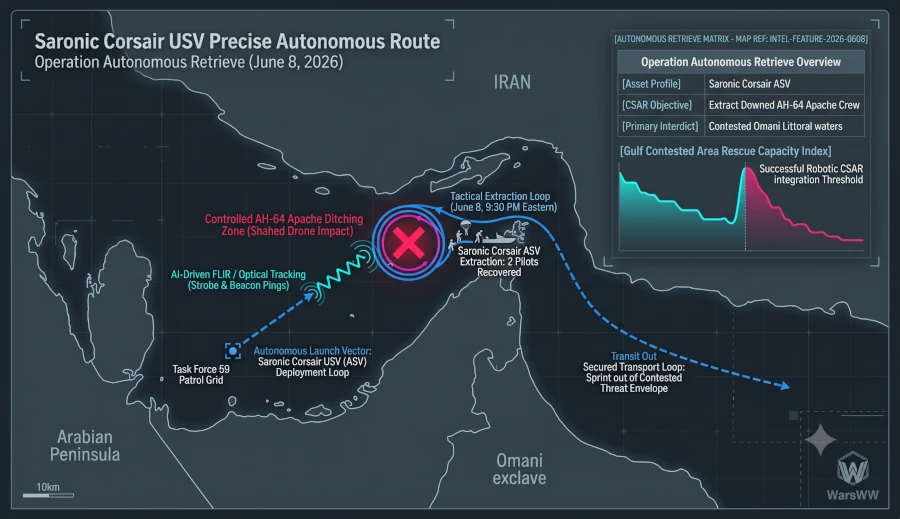
| 8:15 PM: Autonomous Launch | Task Force 59 routes Saronic Corsair ASV into grid | Low cross-section vessel bypasses coastal radar nets |
| 9:30 PM: USV Extraction | Corsair isolates beacon tags and emergency strobe lights | Both aviators safely hoisted from the water onto the hull |
According to post-incident brief tracking data from U.S. Naval Forces Central Command (NAVCENT), an armed Iranian Shahed-type loitering munition collided with the Apache, causing an immediate, uncontrollable cockpit fire.
The crew managed a controlled ditching into the Persian Gulf before the airframe slipped beneath the surface. Both pilots survived the impact and entered the water in stable condition, activating their localized survival beacons.
Under traditional operational doctrines, a downed crew in a theater crawling with surface-to-air threats would require launching an HH-60G Pave Hawk helicopter or specialized combat craft—deployments that expose more human crews to the exact same anti-air vectors that claimed the primary aircraft.
II. The Rescue Asset: The Saronic Corsair Autonomous System
With the crash site situated within range of active Iranian coastal missile defense clusters on Qeshm Island, CENTCOM commanders bypassed manned options. They delegated the mission to Task Force 59, the Fifth Fleet’s dedicated unmanned systems and artificial intelligence cell operating out of Bahrain.
The tool selected for this historic recovery was the Saronic Corsair, a cutting-edge autonomous surface vessel (ASV) that had been deployed to the Middle Eastern theater in late March 2026.
Saronic Corsair ASV Operational Technical Blueprint
| System Parameter | Specification Capacity | Primary Tactical Advantage |
| Hull Length | 24 Feet (7.3 Meters) | Low visual radar profile; highly agile in littoral swells |
| Top Cruising Velocity | In Excess of 35 Knots | Rapid sprint capability to minimize time-to-target windows |
| Operational Range | 1,000 Nautical Miles (NM) | Deep persistent scouting without refueling requirements |
| Payload Capacity | Up to 1,000 Pounds | Capable of carrying specialized recovery gear and multiple personnel |
| Guidance System | AI-Driven / SATCOM Overrides | Fully functional in electronic-warfare jammed zones |
The Corsair is not merely a remote-controlled boat; it is a fully integrated, AI-driven platform manufactured by Texas-based defense firm Saronic Technologies. Built explicitly to deliver scalable, multi-mission capabilities, the vessel features an incredibly low radar cross-section and an onboard sensor array optimized to detect low-profile objects in rough water conditions.
III. The Recovery Sequence: How the “Robot Boat” Found the Crew
Once the Apache’s emergency locator transmitters pinged the tracking grid, Task Force 59 routed a nearby patrolling Corsair toward the coordinates.
- The Sensor Lock: Operating autonomously, the Corsair utilized its forward-looking infrared (FLIR) cameras and optical tracking algorithms to isolate the pilots’ strobe lights and thermal signatures against the sea clutter after they spent roughly two hours in the water.
- The Physical Extraction: Lacking a human crew to throw life rings, the Corsair utilized a specialized personnel recovery kit integrated into its hull design. The vessel maneuvered alongside the aviators, allowing them to pull themselves onto the low-profile aft deck tray designed specifically to support up to 1,000 pounds of payload.
- The Secure Transport Loop: Once the pilots were safely secured inside the hull basin, the Corsair sprinted out of the immediate threat envelope to a secondary, lower-risk location on the water. From there, a conventional naval helicopter executed a standard hoist operation, transferring the uninjured aviators to a regional medical facility for observation.
IV. Strategic Implications: Flipping the Attrition Curve
The successful execution of “Operation Autonomous Retrieve” shifts the paradigm of modern combat search and rescue. The concept of using expendable, low-cost robotic craft to retrieve personnel from heavily defended waters removes a massive vulnerability from the commander’s decision matrix.
As U.S. Fifth Fleet networks continue to test the limits of autonomous hardware, the deployment proves that sea drones have evolved far beyond simple scouting tools or kamikaze platforms. They are now fully capable of executing complex, high-stakes missions where human lives are directly on the line.
V. Indicators to Watch
- [PROCUREMENT] VASP Recovery Modification Fleet Orders: Monitor Department of the Navy contract awards over the next fiscal quarter. Following the Corsair’s historic rescue performance off Oman, watch for immediate budget reallocations aimed at retrofitting existing autonomous fleets with specialized, automated medical and hoist-boarding gear.
- [TACTICAL ENVIRONMENT] Adversary Anti-ASV Priority Adjustments: Track IRGC maritime patrol behavior along the Strait of Hormuz chokepoints. With the realization that the U.S. military can recover downed assets without risking additional personnel, look for adversary fast-attack craft to shift their focus toward hunting and disabling low-profile surface drones before they can reach designated extraction grids.
WarsWW Editorial Intelligence Note [REF: FEATURE-HORMUZ-RESCUE]
The true strategic value of the Corsair rescue is that it completely changes the calculation around human losses in highly contested areas. For decades, the greatest risk of operating close to an adversary’s coast wasn’t losing an aircraft; it was the political and psychological fallout of having pilots captured or killed during high-risk rescue attempts. By using a cheap, expendable robotic boat to pull those soldiers out of harm’s way within a two-hour window, the Pentagon has effectively proved it can maintain an aggressive presence in dangerous waters without giving opponents easy leverage. This development will fundamentally alter how Western commanders plan operations in volatile zones like the Taiwan Strait or the Baltic Sea, marking a permanent shift toward completely automated frontline support.