The War of Hormuz: Transition from Chokepoint Crisis to Open Warfare
Operational Status: ACTIVE REGIONAL CONFLICT / MULTI-AXIS THEATER SATURATION / CEASEFIRE COLLAPSE
Geopolitical Friction Index: 9.99/10 (Absolute Macro-Systemic Attrition)
The terminology surrounding the multi-theater confrontation in West Asia has fundamentally shifted. What began as a volatile naval blockade and an off-shoot of localized regional proxy campaigns has officially converted into what international defense analysts, the United Nations, and combatant states explicitly classify as the 2026 Iran War—popularly dubbed the “War of Hormuz” across global intelligence networks.
The 2026 Iran War Timeline & Operational Evolution
The transition from a localized security crisis to an official state of war followed a systematic breakdown of top-down diplomatic management throughout the first half of 2026.
Operation Epic Fury Launch
February 28, 2026
The United States and Israel initiate a massive, coordinated aerial campaign hitting nearly 900 targets across Iran. The opening wave eliminates top Iranian leadership, including Supreme Leader Ali Khamenei. Iran retaliates with massive missile barrages targeting U.S. regional bases and Gulf Arab commercial hubs.
The Hormuz Maritime Blockade
March 4, 2026
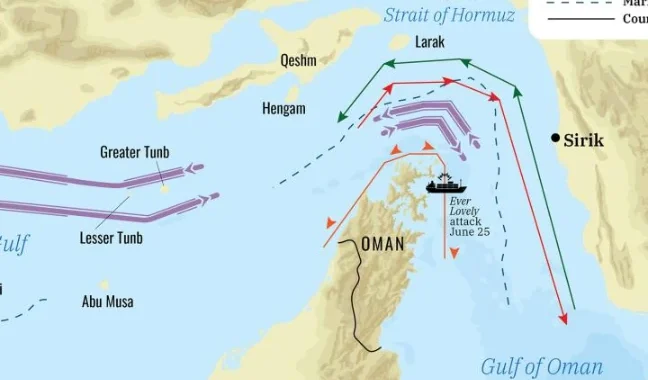
The Islamic Revolutionary Guard Corps (IRGC) officially declares the Strait of Hormuz closed to all shipping tied to the U.S., Israel, and their allies. Tanker traffic drops by 95%, causing the largest oil supply disruption in the history of the modern market.
The Islamabad Framework Pact
June 17, 2026
Following weeks of brinkmanship, a Pakistani-brokered Memorandum of Understanding (MoU) is executed. The 14-point truce establishes a fragile 60-day window to negotiate a final treaty, conditioned on reopening the strait and lifting oil sanctions.
Ceasefire Collapse & Open Warfare
July 7, 2026
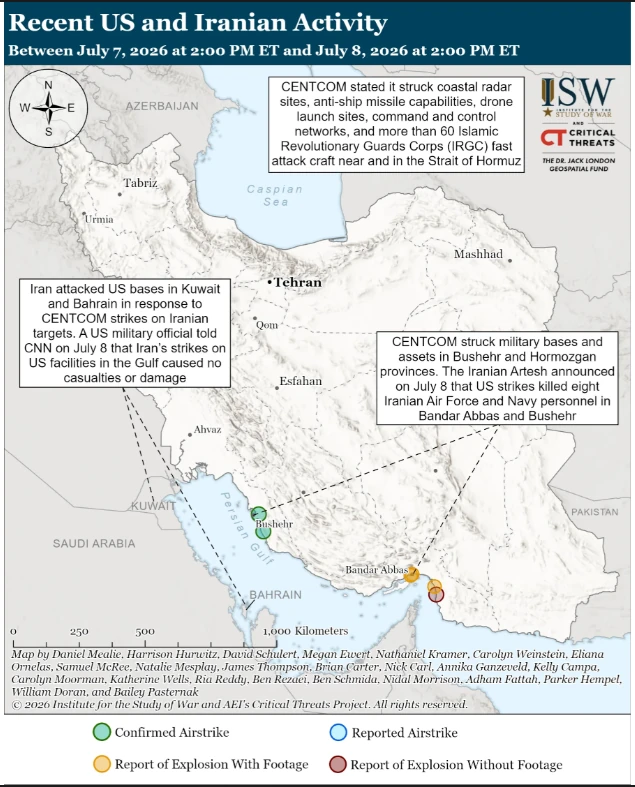
Following Iranian kinetic strikes on three merchant vessels resisting its traffic protocol, U.S. President Donald Trump officially declares the ceasefire “over”. Centcom expands its coastal air campaign while Iran launches retaliatory drone and missile barrages at U.S. infrastructure in Bahrain, Kuwait, Qatar, and Jordan.
Current Theater Assessment: Why It Is Classified as an Active War
The escalation over the past week has removed any ambiguity regarding the legal and operational status of the conflict. The crisis has progressed far beyond “brinkmanship” due to three structural factors:
- Symmetric State-on-State Kinetic Exchanges: The theater is no longer defined by proxy skirmishes. U.S. Central Command recently escalated its operations, launching heavy strikes against 90 coastal targets, air defense systems, and missile storage installations inside Iran. In direct response, the IRGC Navy launched its own multi-province offensive, firing ballistic payloads directly at U.S. military bases across the Persian Gulf.
- Complete Freezing of International Maritime Protocols: The United Nations International Maritime Organization (IMO) has officially suspended its civilian seafarer evacuation missions due to the severe threat of unguided projectiles. Commercial shipping is at a near-standstill, leaving roughly 6,000 international crew members stranded aboard hundreds of idle vessels trapped inside the active combat zone.
- Nullification of Diplomatic Agreements: While diplomatic channels in Oman are attempting to salvage a “median lane” for global liquefied natural gas (LNG) traffic, President Trump formally rescinded the temporary sanctions waivers that allowed Iranian crude to sell at market values, returning the two powers to an absolute, unmitigated state of war.
WarsWW Editorial Intelligence Note [REF: INTEL-DEBRIEF-2026-0711]
The reality of the War of Hormuz reveals a fundamental transition from Proportional Containment to High-Attrition State Warfare. The complete collapse of the Islamabad Memorandum proves that top-down treaties cannot survive when a strategic chokepoint remains a contested military objective. Tehran views absolute structural control of the strait as its ultimate strategic deterrent, and field commanders have shown they are willing to absorb heavy damage to their coastal infrastructure to maintain that leverage.
By abandoning the ceasefire and expanding kinetic strikes to port cities and transit corridors, both Washington and Tehran have prioritized military victory over diplomatic compromise. This shift ensures that even if regional intermediaries succeed in establishing temporary shipping lines, the physical borderlands and vital waterways will remain highly volatile combat sectors for the foreseeable future.