The Fall of “El Mencho” and the CJNG Succession Crisis
Conflict Spotlight: The Fall of “El Mencho” and the CJNG Succession Crisis
Intelligence Status: POST-DECAPITATION INSTABILITY
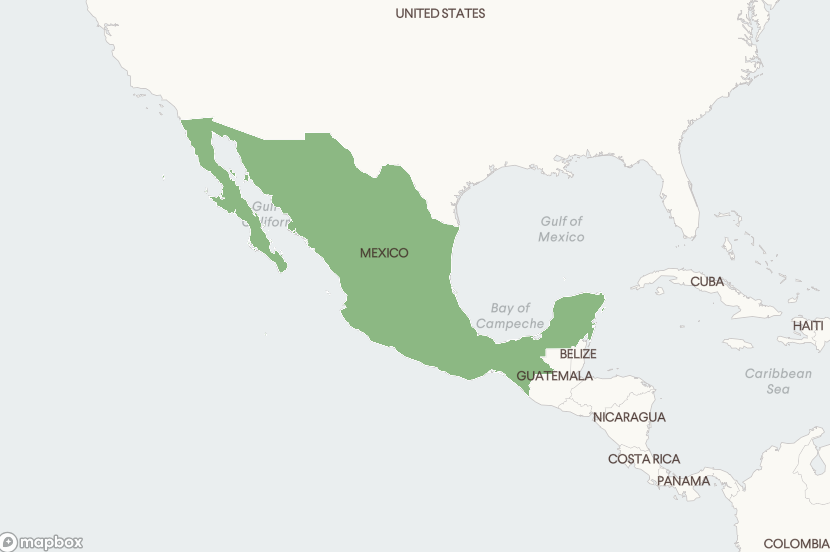
Location: Jalisco, Mexico / Central Pacific Region
Date: April 25, 2026
Following the landmark military operation on February 22, 2026, that resulted in the death of Nemesio Rubén Oseguera Cervantes (alias “El Mencho”), Mexico’s security landscape has entered a volatile transition phase. While the immediate “Code Red” lockdowns have lifted, the Cartel Jalisco Nueva Generación (CJNG) is currently facing an existential succession crisis that threatens to destabilize the region ahead of the 2026 FIFA World Cup [[2.2], [5.1]].
. The Takedown: Intelligence-Led Decapitation
The operation in Tapalpa, Jalisco, was a “major security achievement” for President Claudia Sheinbaum, made possible through unprecedented bilateral cooperation.
- The Intelligence Anchor: The U.S. Joint Interagency Task Force-Counter Cartel (JIATF-CC) provided “complementary” intelligence that allowed Mexican Army Special Forces (SEDENA) and the National Guard to pin El Mencho to a rural “sylvan refuge” [[1.1]].
- The Final Engagement: During the raid, CJNG gunmen used rocket launchers and armored vehicles to repel federal forces. El Mencho was fatally wounded in the exchange and died while being airlifted to Mexico City [[1.2], [4.2]].
- The “Romantic” Lead: Officials revealed the operation was triggered after tracking El Mencho’s location via a visit from a “romantic partner,” a classic human intelligence (HUMINT) vulnerability [[4.1]].
II. Succession Crisis: The Battle for “Sr. Mencho’s” Legacy
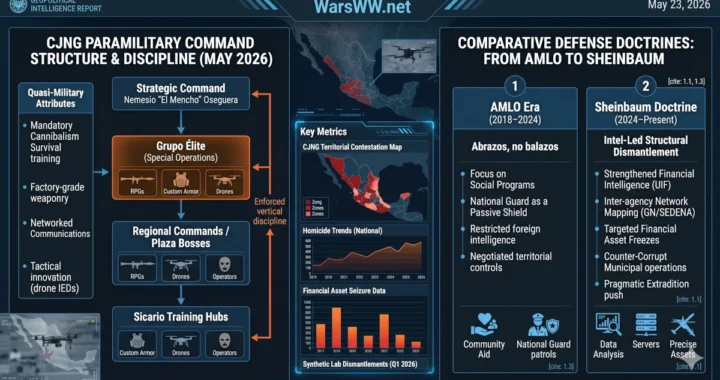
The CJNG is unique in its “projection of force” rather than deep social integration. With its founder gone, the organization is fracturing.
- The Frontrunner: Juan Carlos Valencia González (El Mencho’s stepson and commander of the “Grupo Elite”) has emerged as the primary claimant [[2.1]]. His legitimacy rests on the “Valencia” family name, which founded the cartel’s precursor, the Milenio Cartel.
- Internal Power Struggles: Intelligence analysts at RUSI note that senior regional commanders control enough independent finance and weaponry to form autonomous fiefdoms rather than pledging loyalty to González [[2.1]].
- The “Inauguration” Violence: Former cartel members have described the recent wave of executions and arson as an “inauguration” ritual for the next leader, aimed at proving strength to both subordinates and rivals like the Sinaloa Cartel [[3.2]].
III. Impact on Civil Stability and the 2026 World Cup
The immediate aftermath saw 252 violent incidents across 20 states [[3.2]].
- Civilian Lockdowns: In Guadalajara and Puerto Vallarta, residents were warned via cartel-distributed text messages to stay indoors or face execution. Though “Code Red” was lifted on February 24, a heavy military presence remains to secure infrastructure [[3.2], [5.1]].
- Economic Fallout: The violence has already caused an estimated $1.3 billion loss in visitor spending, creating significant anxiety for FIFA officials as Mexico prepares to co-host the World Cup this summer [[4.1], [5.1]].
- DEA Priority: The U.S. Drug Enforcement Administration (DEA) continues to classify CJNG as a “terrorist organization” and the number one threat to U.S. public health due to its fentanyl trafficking capacity [[3.1]].
WarsWW Intelligence Note [REF: MEX-2026-0425]
The death of El Mencho mirrors the “Strategic Depletion” we see in [Ukraine: Phase 2]. By removing the central node, the state has forced a sprawling military apparatus to turn inward. However, as documented in our [Shadow Air Force] brief, the CJNG’s use of armed drones and landmines means any internal civil war will be fought with high-tech, decentralized weaponry that traditional policing is ill-equipped to handle [[3.2]].
Source Registry: The El Mencho Takedown [REF: CJNG-2026]
| Ref ID | Primary Source | Summary |
| [[1.1]] | Justice in Mexico (Feb 23, 2026) | Detailed breakdown of the Tapalpa operation and U.S. intelligence support. |
| [[1.2]] | Associated Press (Feb 22, 2026) | Initial reporting on El Mencho’s death during transit and the White House reaction. |
| [[2.1]] | RUSI Commentary (Mar 2, 2026) | Analysis of Juan Carlos Valencia González and CJNG fragmentation. |
| [[3.2]] | AMU Edge / Dr. Sadulski (Mar 12, 2026) | Reports on “inauguration” violence and text-message warnings sent to civilians. |
| [[4.1]] | Atlas Institute (Mar 12, 2026) | Economic impact assessment and the “romantic partner” intelligence leak. |
| [[5.1]] | Global Guardian (Feb 26, 2026) | Status of “Code Red” lift and FIFA World Cup security outlook. |
Tactical Sidebar: The CJNG Drone Arsenal
Technical Briefing [REF: MEX-UAS-2026]
The Cartel Jalisco Nueva Generación (CJNG) has evolved from using drones for simple reconnaissance to deploying a sophisticated, multi-tiered aerial fleet. This “Shadow Air Force” is now a standardized feature of their tactical units, particularly the “Jalisco Delta Group,” which utilizes these systems to bypass traditional military checkpoints and enforce regional dominance [[2.2]].
I. The Weaponry: “Potato Bombs” to Multi-Munition Systems
The CJNG’s aerial doctrine is defined by its use of “Improvised Air-Delivered Munitions” (IADMs).
- The “Potato Bomb” (Papa-Bomba): Low-cost, off-the-shelf commercial drones (often DJI or Autel) are fitted with primitive explosive devices packed with nails and metal fragments. In October 2025, three of these devices successfully struck the Baja California state prosecutor’s office in Tijuana, proving the cartel can strike heavily protected urban hubs [[1.1], [4.2]].
- Multi-Munition Drops: More advanced units now use specialized release mechanisms that allow a single drone to drop multiple grenades or IEDs in a “carpet bombing” pattern. This tactic was extensively used in Michoacán to clear entire villages, driving out tens of thousands of civilians to overcome the “home-base advantage” of local community defense forces [[1.1], [3.2]].
- FPV “Suicide” Drones: Mirroring tactics from the [Russo-Ukrainian War: Phase 2], the CJNG has begun deploying First-Person View (FPV) racing drones that detonate on contact. These are specifically used for precision assassinations of high-ranking rivals or police commanders [[1.2], [4.2]].
II. Tactical Innovation & Specialized Units
The cartel has moved beyond ad-hoc usage into formal military-style organization:
- The Drone Squads: CJNG has established specialized “Drone Units” with standardized training. Intelligence reports from April 18, 2026, suggest these units are now experimenting with fiber-optic command-and-control to bypass military signal jammers [[2.2]].
- Foreign Expertise: In a startling development, the Mexican National Intelligence Center confirmed that some cartel volunteers joined foreign fighter units in Europe specifically to learn advanced drone piloting. There are also reports of the CJNG recruiting Colombian mercenaries to manage their aerial surveillance and EOD (Explosive Ordnance Disposal) canine units [[3.3], [4.2]].
- Electronic License Plates: To evade detection, cartel hackers are reportedly stealing the “electronic signatures” of registered commercial drones, allowing their weaponized platforms to appear as legitimate delivery or photography flights on local radar [[1.1]].
III. Countermeasures & Border Tension
The proliferation of these drones has created a “security nightmare” on both sides of the border.
- The El Paso Incident (February 2026): U.S. anti-drone operations recently turned into a “double FUBAR” near El Paso, where the U.S. military accidentally shot down a CBP (Customs and Border Protection) drone with a laser during a chaotic scramble to intercept suspected cartel UAS activity [[4.2]].
- World Cup 2026 Readiness: As of February 17, 2026, the Mexican Army has deployed a “special anti-drone battalion” specifically tasked with protecting 2026 FIFA World Cup venues from aerial IED attacks [[1.1]].
WarsWW Intelligence Note: The CJNG’s drone capability has turned the “War on Cartels” into a high-tech conflict where traditional ground superiority no longer guarantees safety. As noted in our [Shadow Air Force] deep-dive, the democratization of drone technology has allowed non-state actors to achieve “surgical strike” capabilities once reserved for sovereign nations.
Source Registry: CJNG Drone Warfare [REF: UAS-2026]
| Ref ID | Primary Source | Report Summary |
| [[1.1]] | Brookings Institution (Feb 18, 2026) | Comprehensive analysis of “carpet bombing” tactics in Michoacán and drone signature hacking. |
| [[1.2]] | Small Wars Journal (Feb 16, 2026) | Data on 221 weaponized drone incidents; CJNG holds the largest share (19%) of attributed attacks. |
| [[2.2]] | Grey Dynamics (Apr 18, 2026) | Reports on specialized “Jalisco Delta” drone units and the move to fiber-optic command links. |
| [[3.3]] | Milenio News (Apr 13, 2026) | Confirmation of Colombian mercenaries being recruited for drone surveillance in Michoacán. |
| [[4.2]] | Texas Public Radio (Mar 2, 2026) | Detailed report on the El Paso “friendly fire” incident and the limitations of military-grade jammers. |