Ukraine Drones Strike Kronstadt Baltic Fleet Israel Strike Kills Lebanese General
WarsWW Daily Brief | June 6, 2026
Intelligence Status: DEEP REFUGE BREACH / MARITIME CHOKEPOINT ATTRICTION / BORDER AGREEMENT FRACTION
Global Security Index: 9.99/10 (Critical Systemic Rupture)
UKRAINIAN SPECIAL FORCES PENETRATE 1,000KM TO STRIKE KRONSTADT BALTIC NAVAL BASE DURING PUTIN FORUM; ISRAELI AIRSTRIKE KILLS LEBANESE ARMY GENERAL AND TWO SOLDIERS IN SOUTH LEBANON; TEHRAN AND BEIRUT ENGAGE IN FURIOUS DIPLOMATIC FEUD OVER CEASEFIRE COLLAPSE.
I. Eastern Europe: The 1,000-Kilometer Baltic Intercept and the SPIEF Saturation Campaign
The asymmetric air war between Kyiv and Moscow has broken geographic boundaries, shifting from localized front-line friction to a highly coordinated, ultra-long-range strategic strike network. Ukrainian unmanned assets have executed their deepest maritime infrastructure penetration since the launch of the summer campaign.
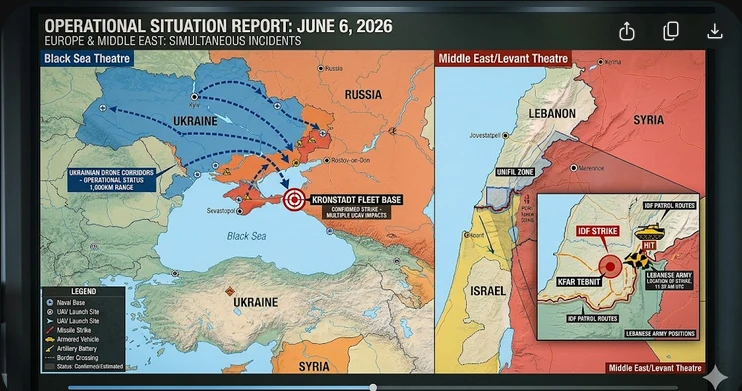
- The Kronstadt Baltic Fleet Raid: Spearheaded by the Security Service of Ukraine (SBU) alongside specialized Unmanned Systems Forces (SBS), Ukrainian long-range strike drones flew over 1,000 kilometers deep into Russian territory to strike the Kronstadt naval base near St. Petersburg. The precision vectors bypassed extensive regional radar tracking networks, triggering visible columns of heavy black smoke near the Kronstadt Marine Plant—the central industrial facility responsible for maintaining the Baltic Fleet’s surface and submarine hulls.
- The 15th Naval Arsenal Detonation: Concurrently, matching waves targeted neighboring naval aviation nodes. Intelligence indicators verified significant secondary detonations at the Russian Navy’s 15th Arsenal in Lebyazhye, Leningrad Oblast, where long-range maritime missiles and specialized ammunition reserves are stored. The strategic strike lines intentionally coincided with the high-profile finale of the 2026 St. Petersburg International Economic Forum (SPIEF), completely undermining the Kremlin’s narrative of domestic defense insulation.
- The 376-Vector Defensive Claims: To mitigate the optical fallout, the Russian Ministry of Defense asserted that its electronic warfare and air defense nets neutralized 376 Ukrainian drones overnight across 16 provinces, including more than 140 intercepts claimed over the Leningrad administrative district alone. However, parallel impacts successfully ignited a 5,000-square-meter fire at the Poltavskaya oil depot in Krasnodar Krai, forcing the emergency evacuation of 60 nearby residential properties.
- The Front-Line FPV Interdicts: In the domestic theater, Russian tactical forces relied heavily on first-person view (FPV) munitions to disrupt civilian areas. Separate morning FPV drone strikes killed a 51-year-old scooter rider in Kharkiv and a 50-year-old resident in Kramatorsk. In the Zaporizhzhia zone, search-and-rescue teams recovered the bodies of two men from rubble following a heavy ballistic strike.
II. Middle East: The Nabatiyeh General Strike and the Collapse of the Washington Truce
The fragile, U.S.-brokered bilateral ceasefire blueprint signed between Israel and the Lebanese government has suffered a devastating tactical break, as active combat loops directly entangle sovereign state military forces.
Levant Front-Line Attrition Matrix
| Operational Zone | Primary Kinetic Asset | Target Profile / Location | Current Strategic Attrition Status |
| Kfar Tebnit Route | IDF Tactical Strike Vector | Lebanese Army Logistics Vehicle | Brigadier General, Captain, and 1 Soldier dead |
| Saksakiyah District | Israeli Air Force Guided Missile | Residential Refugee Center | 6 Civilians Dead; 4 wounded; structure destroyed |
| Southern Border Line | Hezbollah Low-Altitude UAV Swarm | Advancing IDF Armored Columns | Continuous tracking; intercept loops active |
| Tehran Command | Foreign Ministry Diplomatic Memo | Washington Ceasefire Text | Complete political rejection; verbal escalation |
- The Assassination of the Brigadier General: Deepening the regional crisis, an Israeli airstrike targeted a military vehicle on the road between Kfar Tebnit and Khardali, directly killing a Lebanese Army Brigadier General, a Captain, and an accompanying soldier. Lebanese President Joseph Aoun immediately condemned the strike, labeling it a flagrant violation of Lebanese sovereignty and international law. The IDF later confirmed the strike, claiming the vehicle was moving suspiciously in an active combat zone without coordination, following concrete intelligence indicators that Hezbollah was preparing an anti-tank missile launch from the exact same quadrant.
- The Saksakiyah Refugee Strike: Parallel air operations targeted suspected militant storage blocks further north. A separate Israeli airstrike on the southern coastal village of Saksakiyah killed six civilians and wounded four others, completely shattering the provisional truce parameters.
- The Tehran Bargaining Chip Feud: The kinetic escalation has triggered an acute diplomatic shouting match between Beirut and Tehran. Following statements from Lebanese officials lambasting Iran for using their population as a bargaining chip, Iranian Foreign Minister Abbas Araghchi rejected the criticism via official social channels, sarcastically retorting that Lebanese leaders speak as if Iran occupied their territory rather than Israel, while noting that if Lebanon were truly a chip for Tehran, a deal with Washington would have been finalized months ago.
III. Featured Visual Intelligence Archive [REF: INTEL-MAP-2026-0606]
Figure 1 (Top image): Comprehensive operational map highlighting the 1,000-kilometer Ukrainian drone corridors striking the Kronstadt Fleet Base next to tactical indicators showing the location of the IDF strike on the Lebanese Army vehicle near Kfar Tebnit, June 6, 2026.
IV. Indicators to Watch
- [LOGISTICS] Lebanese Armed Forces Mobilization: Monitor defensive deployments exiting Beirut. Following the deaths of its senior brigade officers under Israeli air fire, watch whether the regular Lebanese military ceases its enforcement of the U.S.-brokered “pilot zones” and pulls back from active border areas, leaving a security vacuum for Hezbollah to fully reoccupy.
- [ENERGY FUTURES] Supplementary Budget Enactments: Track monetary policy adjustments in the Asia-Pacific. Following Japan’s enactment of a massive 3.11-trillion-yen supplementary budget to buffer its domestic markets from rising fuel costs linked to Middle Eastern naval blockades, look for similar emergency spending allocations from South Korea and Germany as energy transport lines face open-ended disruption.
WarsWW Intelligence Note [REF: DAILY-2026-0606]
The international arena is experiencing Systemic Institutional De-synchronization. The simultaneous execution of Ukraine’s 1,000-kilometer strike on the Baltic Fleet and Israel’s fatal engagement with the regular Lebanese military proves that localized command loops are completely operating outside formal diplomatic frameworks. Washington’s attempts to decouple the Levant conflict from the broader Persian Gulf theater have functionally failed. Because Hezbollah maintains a total veto over the Lebanese state’s sovereign commitments, and the Kremlin remains unable to insulate its core naval yards from long-range saturation, the prospects for a negotiated settlement are entirely secondary to the raw speed of material and structural attrition on the ground.