Pentagon Removes 180 Faiths Military Recognized Religions List Hegseth
WarsWW Intelligence Brief: Pentagon Restructures Chaplaincy Infrastructure, Removing 180 Faith Codes
Intelligence Status: DOMESTIC STRATEGIC REALIGNMENT / CHAPLAINCY RESTRUCTURING / ADMINISTRATIVE EXCLUSION MATRIX
Global Security Index: 9.97/10 (High Systemic Friction)
I. The Policy Shift: Streamlining the Military Faith Matrix
The Department of Defense (DoD) has executed its first comprehensive overhaul of military religious preference coding in nearly a decade, triggering severe domestic friction. In an operational directive aimed at fundamentally reshaping the logistics of spiritual readiness within the armed forces, the Pentagon has slashed its officially recognized list of faiths and worldviews.
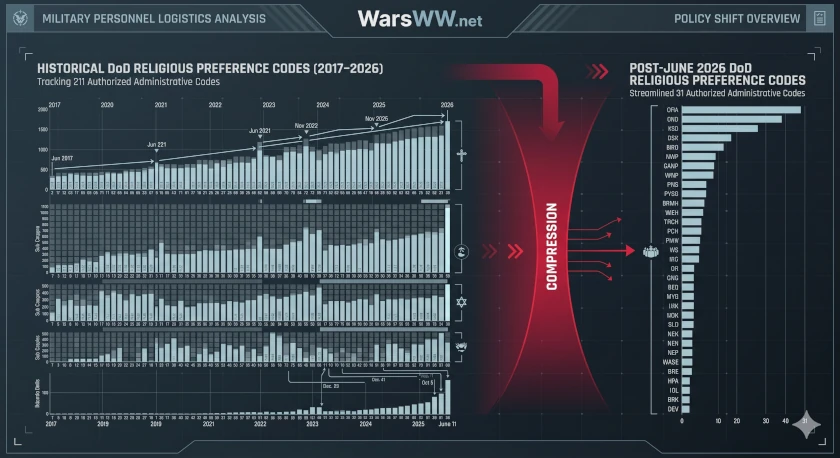
- The Administrative Squeeze: According to official department documentation, the Pentagon has officially reduced its recognized list of faiths and belief systems from approximately 211 down to just 31. The aggressive administrative consolidation marks the first formal revision to the military’s tracking codes since a major expansion was enacted on March 27, 2017.
- The Command Directive: The sweeping policy shift was formalized via a memorandum signed by Anthony Tata, Under Secretary of Defense for Personnel and Readiness. The text explicitly establishes that the restructuring was executed at the direct guidance of Defense Secretary Pete Hegseth. The primary stated objective of the policy is to thoroughly streamline data collection mechanisms, allowing the Chaplaincy Corps to enhance the delivery of targeted religious support across core cohorts.
- The 60-Day Transformation Horizon: The memorandum mandates that all existing military database infrastructure, intake files, and personnel tracking loops must adapt to the newly condensed 31-code framework within a strict 60-day implementation period.
II. The Omission Profile: Broad vs. Excluded Worldviews
The contraction of the military preference registry has drawn intense scrutiny from civil liberties organizations and minority faith practitioners due to the specific categories targeted for structural removal.
- The Retained Core: The newly restricted 31-code database continues to preserve administrative tracking for major global traditions. The remaining categories include Agnostics, Buddhists, Hindus, Muslims, Jews, Sikhs, and Bahá’ís, alongside a heavily itemized breakdown of established Christian traditions including Baptists, Catholics, Lutherans, Methodists, and Pentecostals.
- The Minority Purge: The 180 eliminated codes represent a comprehensive exclusion of alternative spiritual frameworks, minor sects, and secular philosophies. Service members are no longer permitted to officially register as Atheists, Humanists, Deists, Unitarian Universalists, Druids, Pagans, Wiccans, Heathens, or practitioners of Asatru. Personnel identifying with these purged worldviews will instead be funneled into generic administrative designations such as “Other Religions” or “No Religion.”
III. Featured Visual Intelligence Archive [REF: INTEL-MAP-2026-0605-FAITH]
Revised DoD Religious Preference Tracking Architecture
| Active Faith Code Designation | Post-June 2026 Policy Status | Impacted Military Demographic | Core Justification Profile |
| Major Christian Denominations | Retained & Segmented | Estimated 82% of religiously affiliated personnel | Mainstream tracking alignment |
| Atheist / Secular Humanist | Completely Extinguished | Secular and non-theistic service cohorts | Deemed administrative bloat |
| Minority / Alternative Creeds | Completely Extinguished | Wiccan, Pagan, Asatru, and Druid tactical teams | Unused or underutilized codes |
| Agnostic / No Religion / Other | Retained as Catch-All | Broad unaligned personnel pool | Consolidating data management loops |
IV. The Backlash: Operational Readiness and First Amendment Friction
Pentagon leadership has vigorously defended the policy transition as a practical necessity. Defense Secretary Hegseth previously noted that the historical registry had ballooned to an impractical, unwieldy layout, emphasizing that many specific alternative codes were rarely or never selected by active-duty service members. Hegseth asserted that a streamlined architecture allows chaplains to more effectively allocate resources toward the baseline spiritual configurations making up the vast majority of the ranks.
However, the decision has ignited a major wave of domestic condemnation from advocacy networks and veteran associations. The Military Religious Freedom Foundation (MRFF), led by Mikey Weinstein, sharply lambasted the code reduction, labeling it an unconstitutional, unethical attempt to shift the military landscape closer to Christian nationalism.
Critics and former military chaplains warn that stripping individual codes makes it substantially harder for minority practitioners to access appropriate, protected spiritual care. They argue that forcing marginalized demographics under a vague “Other” label risks alienating personnel, hurting morale, and complicating the long-term planning required to provide diverse religious support in forward deployment theaters.
V. Indicators to Watch
- [LEGAL INTERDICTION] Constitutional Litigation Filings: Monitor federal court dockets over the next 14 days. Watch for immediate civil rights filings from secular and minority religious advocacy groups seeking a nationwide injunction against the Tata-signed memo, arguing the exclusion violates the First Amendment’s Establishment and Free Exercise clauses.
- [LOGISTICS LOGS] Identification Tag Allocation Changes: Track whether individual branches implement parallel restrictions on physical hardware. While the memo notes that service members are not strictly limited by the 31 codes when formatting standard dog tags, watch for localized supply chain changes or automated database errors if military base tagging software is forced to mirror the condensed database.
WarsWW Intelligence Note [REF: DAILY-2026-0605-FAITH]
The structural consolidation of the military’s faith coding system represents an intentional shift toward Homogenized Personnel Control. Throughout the initial expansion phase of 2017, the defense apparatus operated under a pluralistic data model; it assumed that capturing highly granular demographic trends strengthened the resilience of forward chaplaincy loops. The reversal of this policy under the current Pentagon command signals a profound change in institutional philosophy. By framing diverse spiritual profiles as administrative bloat, the defense leadership is actively prioritizing simplified managerial tracking over individualized accommodation. In a high-intensity recruitment and retention landscape, this administrative contraction may inadvertently exacerbate domestic culture-war lines, creating friction inside the ranks just as the overarching geopolitical environment requires absolute domestic cohesion.