
Ukrainian farmers to the brink of crisis: Hormuz Blockade
Global Food Chain Fractures: Ukraine Braces for 20% Yield Drop as Hormuz Blockade Chokes Fertilizer Supply
KYIV/NEW YORK — A secondary front has opened in the 2026 global conflict, one fought not with missiles, but with the chemical building blocks of life. Ukrainian farmers, already weathered by years of domestic war, are now facing a “catastrophic” input deficit as the U.S.-Israeli war on Iran enters its second month, effectively severing the world’s most critical artery for agricultural nutrients.
The crisis follows the February 28 initiation of Operation Epic Fury, which saw coordinated strikes on Tehran and the elimination of Iranian leadership. In retaliation, Tehran and its allies have successfully obstructed commercial traffic through the Strait of Hormuz, trapping millions of tons of fertilizer and raw materials behind a naval chokepoint.
The Numbers: A Deficit in the Breadbasket
For Ukraine, the timing could not be worse. The blockade has hit just as the spring planting season begins, a window that agricultural historians warn is the worst possible time for a supply shock.
- Yield Projections: Agronomists in Kyiv estimate that the lack of nitrogen-based fertilizers could slash crop yields by up to 20% this year.
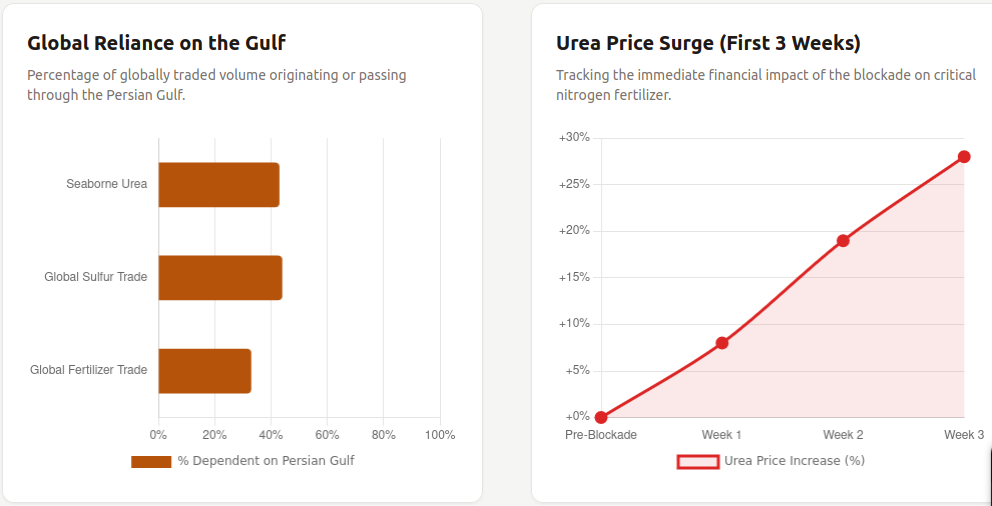
- Volume at Risk: The Persian Gulf accounts for roughly one-third of global seaborne trade in fertilizers. This includes 43% of the world’s seaborne urea and a significant portion of ammonia and sulfur.
- Price Spikes: In the first three weeks of the blockade, urea prices surged over 28%, far outstripping the price increases of the crops themselves.
The “Sulfur Cascade” and Fertilizer Types
The shortage is not limited to finished products. The Strait of Hormuz is a primary conduit for Sulfur, a byproduct of oil and gas refining.
Gulf countries produce 44% of globally traded sulfur, which is essential for producing sulfuric acid—the reagent used to turn phosphate rock into plant-absorbable liquid fertilizer. This “Sulfur Cascade” has neutralized phosphate production in countries like Morocco and China, further tightening the global supply of MAP (Mono-Ammonium Phosphate) and DAP (Di-Ammonium Phosphate).
Humanitarian Fallout: “Flashing Red”
The disruption is triggering a humanitarian ripple effect far beyond the borders of the conflict.
- Global Hunger: The World Bank reports a 20% increase in acute food insecurity since the beginning of the decade, a trend now accelerated by the Middle East crisis.
- Aid Collapse: In Somalia, UNICEF has warned that 2 million children are at risk of acute malnutrition as the cost of importing food and fuel skyrockets due to the shipping disruptions.
- The Safety Net: Experts note that unlike the 2022 crisis, the U.S. Agency for International Development (USAID) has seen significant rollbacks, leaving many developing nations without a buffer against rising food costs.
Affected Nations and Strategic Shifts
While Ukraine is at the “end of the supply chain” and highly vulnerable, other major agricultural powers are reeling:
- Brazil: Extremely dependent on Middle Eastern urea for its soybean crops, which feed livestock globally.
- India & Bangladesh: Production at domestic fertilizer plants has ceased because natural gas supplies from Qatar have been severed.
- United States: While less dependent on Hormuz for direct imports, the U.S. relies on Saudi phosphate and is seeing “New Orleans” urea prices climb by 30% or more.
Seeking Alternatives
As the “worst-case scenario” for global food security unfolds, the industry is looking toward radical alternatives:
Geopolitical Realignment: If the blockade persists, Russia, Belarus, and China are poised to gain immense leverage as the only major suppliers with available fertilizer surplus, potentially reshaping global alliances.
Distributed Production: Experts are advocating for decentralized, farm-scale ammonia production powered by renewable energy, which could theoretically produce 96% of the world’s nitrogen locally.
Agroecology: Some groups suggest diversifying crop rotations and using cover crops can reduce nitrogen requirements by up to 90%, though “earning the right” to reduce inputs takes years of soil preparation.