Barakah Nuclear Plant Drone Strike Lebanon Yellow Line North Korea Missile Test 2026
WarsWW Daily Brief | May 27, 2026
Intelligence Status: GEO-NUCLEAR INTERDICTION / EXPANDED FRONTLINE BUFFERS / ASYMMETRIC SATURATION Global Security Index: 9.97/10 (Extreme Structural Strain)
I. Middle East: The Barakah Nuclear Strike & The Ground Push Beyond the Yellow Line
The parallel wars in the Middle East have converged into a single, high-consequence operational emergency, entirely fracturing the fragile diplomacy running through Islamabad and Doha.
1. The Barakah Nuclear Incident
The UN Security Council has convened an emergency session in New York following a coordinated drone strike targeting the Barakah Nuclear Power Plant in the United Arab Emirates’ Al Dhafra region.
- The Vector: Three long-range suicide drones crossed the UAE’s western border from Iraqi territory. While federal defensive grids successfully intercepted two vectors, one drone evaded terminal defense systems, striking an electrical generator immediately outside the facility’s inner site perimeter.
- The Consequences: IAEA Director General Rafael Mariano Grossi confirmed that while radiation levels remain normal and a catastrophic meltdown was narrowly averted via emergency diesel generators, a direct hit to the core or a prolonged grid disconnection could have initiated a radioactive release affecting hundreds of kilometers.
2. The Yellow Line Breach in Lebanon
On the northern front, the Israel Defense Forces (IDF) have completely abandoned the structural constraints of the mid-April truce framework.
- The 120-Strike Blitz: The IDF unleashed an intense 120-airstrike bombardment in 24 hours, killing 31 people—including four children and three women—primarily near Tyre and the West Bekaa region.
- The New Buffer Zone: Military officials confirmed that IDF armored units have formally begun operations beyond the “Yellow Line”—a self-declared boundary stretching roughly 10 kilometers (6 miles) deep into sovereign Lebanese territory. Netanyahu defended the operational expansion, stating that troops are securing dominant tactical high-grounds to build a permanent, fortified security buffer zone. Hezbollah forces are actively resisting the advance, employing guided anti-tank missiles and rocket salvos to check the push near Zawtar al-Sharqiyah.
3. The Bandar Abbas Strike Resolution
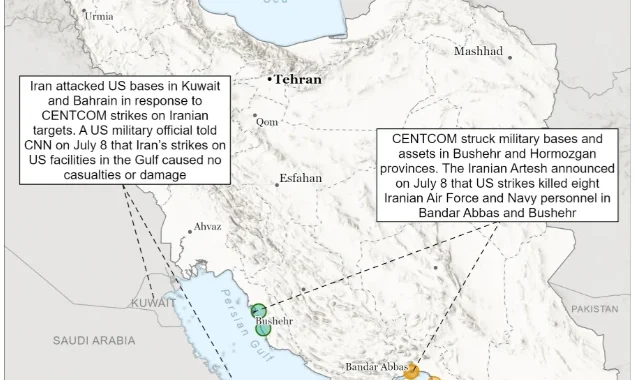
More details have stabilized following the U.S. CENTCOM kinetic intervention inside the Strait of Hormuz. While Iranian diplomats sat at the negotiating table, the IRGC Navy was caught utilizing specialized hovercraft to lay sea mines across international shipping lanes. A US Navy SEAD package deploying F/A-18 Super Hornets and standoff weapons evaporated the minelaying hovercraft and neutralized Iran’s flagship Bavar-373 SAM system near Bandar Abbas after it attempted to lock onto patrolling U.S. air assets.
II. East Asia: Pyongyang’s Multi-Purpose Cluster Weapon Demonstration
Taking immediate tactical advantage of eroding international norms and Western focus distraction, North Korea has conducted its eighth major weapons demonstration of the year.
- The West Coast Launch: Overseen directly by Kim Jong Un, North Korea launched a short-range tactical ballistic missile and guided artillery rockets from Jongju off its western coast, flying approximately 80 kilometers (50 miles) into the Yellow Sea.
- The Precision Complex: State media (KCNA) confirmed the test was designed to analyze the reliability of a new lightweight multi-purpose missile launching system integrating an ultra-precision autonomous navigation system and specialized cluster bomb warheads. Regional defense analysts warn this complex highlights automated, long-range conventional firepower engineered to saturate frontline targets well below the nuclear threshold.
                 [NORTH KOREAN FRONTLINE COMPLEX]

                     [Mobile Lightweight TEL]
                                │
        ┌───────────────────────┼───────────────────────┐
        ▼                       ▼                       ▼
 [Tactical Cruise]       [Guided 240mm MLRS]     [Short-Range Ballistic]
 (Low-Alt Penetration)   (Precision Navigation)  (Cluster Sub-munitions)
        │                       │                       │
        └───────────────────────┼───────────────────────┘
                                ▼
               [ फ्रंटलाइन सैचुरेशन / Area Denial]
III. Counter-Narcotics: The Maritime Interdiction Push
Amidst the multi-theater military strain, federal intelligence networks have scaled up intercept protocols along the Caribbean and Pacific transit corridors to block cartels utilizing the global defense chaos to flood logistics nodes. Joint task forces have intercepted three low-profile semi-submersibles (narco-subs) utilizing advanced satellite tracking overlays, successfully seizing over 12 metric tons of synthetic precursors and cocaine bound for North American entry points.
IV. Indicators to Watch
- [NUCLEAR SECURITY] Barakah Ex-Atmospheric Perimeter: Monitor the flight telemetry of patch-reconnaissance UAVs over Iraq’s southern border. If Abu Dhabi verifies that the drone teams targeting the Barakah nuclear infrastructure are operating out of specific Iraqi militia depots, expect direct UAE or allied kinetic reprisal strikes against those installations.
- [LOGISTICS] The Yellow Line Logistical Corridor: Watch the construction footprint of the IDF engineers in southern Lebanon. If heavy equipment begins establishing semi-permanent bases beyond the 10km Yellow Line boundary, it indicates that Tel Aviv has structurally decoupled from U.S. diplomatic exit strategies and is planning a long-term occupational posture.
WarsWW Intelligence Note [REF: DAILY-2026-0527]
The international security architecture is experiencing systemic failure. The drone strike on the Barakah Nuclear Power Plant demonstrates that regional proxies now view zero-tolerance nuclear energy infrastructure as fair game. Simultaneously, North Korea’s rollout of automated cluster complexes, paired with Israel’s deep push past the Yellow Line in Lebanon, proves that state actors are moving aggressively to establish physical facts on the ground while international enforcement frameworks are entirely locked down in the U.S.-Iran-Russia gridlock.
This analytical breakdown details how the SEAD package dismantled the Bavar-373 anti-air infrastructure while keeping negotiations active on the parallel diplomatic track.