Oreshnik Missile Mechanics; Czech Ammunition Coalition Collapse
WarsWW Strategic Analysis: The Oreshnik’s Kinematic Architecture & Europe’s Splintering Supply Lines [REF: TECH-SUPPLY-2026]
Strategic Status: EX-ATMOSPHERIC SATURATION / ALLIANCE BURDEN SHIFT
Theater Dynamics: Hypersonic Extortion vs. Logistical Depletion
SPOTLIGHT: ORESHNIK MACH 11 MIRV CASCADE EXPLAINED AS RUSSIAN ULTRA-BARRAGE THREATENS KYIV HUB; CZECH AMMUNITION PIPELINE CRIPPLED AS NINE COUNTRIES WITHDRAW CAPITAL; U.S. DEPLOYS CORE MUTATIONS UNDER PURL TO MIDDLE EAST FRONT.”
I. Technical Breakdown: The Mechanics Behind the Oreshnik Diplomatic Pressure
The Kremlin’s current “evacuation ultimatum” issued to foreign diplomats in Kyiv is heavily enforced by the unique tactical mechanics of the Oreshnik intermediate-range ballistic missile (IRBM). Engineered specifically to circumvent regional theater air defenses, the platform relies on extreme physics and a cascading terminal separation sequence to achieve its objectives:
1. Shortened Boost Phase & The Detection Vacuum
Derived by removing a booster stage from the legacy RS-26 Rubezh ICBM architecture, the Oreshnik utilizes high-impulse, solid-propellant rocket motors housed inside a lightweight aluminum alloy and composite hull. This gives the system an exceptionally fast, high-energy boost phase from its mobile 8×8 or 10×10 Transporter-Erector-Launcher (TEL) chassis. By burning out quickly while climbing on a lofted trajectory, the missile significantly minimizes the detection window for Western space-based infrared early-warning sensors.
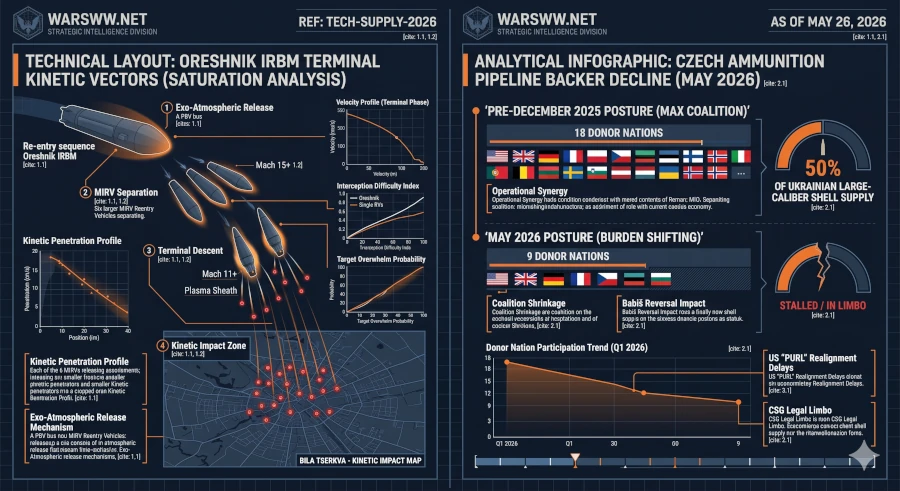
[THE ORESHNIK TERMINAL VECTOR STREAM]
[Exo-Atmospheric Release]     ►    [Atmospheric Re-entry Interface]
─────────────────────────────       ───────────────────────────────────
• Releases 6 MIRV Warheads          • Speed Accelerates to Mach 10-11
• Independent Trajectories          • Plasma Sheath Envelops Warheads
│
▼
[36x Hyper-Velocity Projectiles]
• Overwhelms Battery Radars
• Massive Kinetic Destruction
2. The MIRV-to-Submunition Cascade
The core operational advantage of the Oreshnik is its Multiple Independently Targetable Reentry Vehicle (MIRV) payload bus.
- Upon reaching suborbital apogee, the payload section splits, releasing six independent re-entry warheads.
- As these warheads dive back into the upper atmosphere at terminal velocities exceeding Mach 10 to Mach 11 (12,300+ km/h), friction generates a glowing plasma sheath around the bodies.
- In the final terminal stage, each of the six warheads releases an additional six independent kinetic or explosive sub-munitions, generating 36 distinct, hyper-velocity projectiles falling simultaneously onto a localized grid.
3. Kinetic Penetration Profile
Even when configured with inert or “dummy” payloads—as tracked in initial operational deployments—the Oreshnik delivers a catastrophic amount of energy. The sheer momentum of 36 independent 30-to-70 kg objects striking the ground at Mach 11 generates a localized shockwave equivalent to a conventional heavy missile barrage or a low-yield nuclear overpressure area. This allows Russia to threaten the total structural destruction of hardened command bunkers, industrial corridors, and decision-making centers across European capitals within minutes of a launch notification, rendering standard tactical interceptors entirely obsolete.
II. The Fracturing Coalition: Burden Shifting & The Czech Ammunition Deficit
While Moscow utilizes the Oreshnik to project absolute kinetic dominance, Ukraine’s defensive capabilities are facing a critical political bottleneck. The European coalition backing Kyiv is experiencing severe structural fatigue, culminating in a major crisis inside the vital Czech-led ammunition procurement pipeline.
1. The Czech-Led Ammunition Collapse
The strategic initiative masterminded by Prague to acquire and deliver over 4 million large-caliber artillery shells to Kyiv from non-NATO suppliers has suddenly slowed. Following the return of populist Prime Minister Andrej Babiš to office in December on a pledge to prioritize domestic funds over foreign aid, the number of countries financially backing the ammunition coalition has plummeted from 18 down to just nine.
[CZECH AMMUNITION PIPELINE SHRINKAGE]
[CZECH AMMUNITION PIPELINE SHRINKAGE]
[Pre-December 2025 Posture]      ►       [Current May 2026 Posture]
─────────────────────────────────       ─────────────────────────────────
• 18 Financial Donor Nations            • 9 Active Donor Nations
• Sustained 50% of Shell Supply         • Pipeline Stalled / In Limbo
President Petr Pavel confirmed that this coalition shrinkage leaves the project under extreme burden-sharing strain. Babiš has redirected public capital toward stabilizing domestic energy bills following the economic shocks of the Middle East conflict, leaving the corporate partners at Czechoslovak Group (CSG) in a legal limbo. Because this specific pipeline has historically supplied up to 50% of all large-caliber ammunition deployed by Ukrainian artillery units, the sudden withdrawal of half its European financial donors threatens a profound frontline shell deficit ahead of the July NATO summit.
2. The U.S. “PURL” Realignment Delays
Compounding Europe’s domestic political withdrawal is an acute logistical bottleneck caused by Washington’s prioritization of the West Asia theater.
Under the Foreign Military Sales framework and the parallel PURL agreements, multiple European frontline allies—including the United Kingdom, Poland, Lithuania, and Estonia—act as intermediary conduits, paying for advanced U.S. munitions to facilitate onward delivery to Ukraine. However, following the high-intensity air engagements of the U.S.-Israeli conflict against Iran, Washington has informed these European allies to brace for protracted, long-term delays in the arrival of critical weapon systems.
The delays hit the exact assets Ukraine relies upon to match Russian infrastructure strikes: HIMARS rocket pods and NASAMS air defense interceptor missiles. This shift from a predictable regional alliance architecture to a transactional model reallocating contracted hardware based on active U.S. operational priorities has left Eastern Europe structurally exposed.
WarsWW Intelligence Note [REF: TECH-SUPPLY-0526]
The Kremlin is executing a highly coordinated pincer movement against Western resolve. By displaying a mathematically un-interceptable, 36-vector hypersonic strike mechanism like the Oreshnik, Russia maximizes the psychological terror threshold targeting European capitals. Simultaneously, Moscow is counting on political exhaustion to do the rest. The collapse of the Czech ammunition initiative down to nine participating nations, paired with Washington’s systemic redirection of HIMARS and NASAMS stockpiles toward its own Middle Eastern accounts, means Ukraine is being squeezed on both ends. If European leadership cannot find the political will to bypass individual domestic transitions, the frontline defensive shell barrier will collapse just as Russia’s “systemic strike” envelope opens.