CJNG Paramilitary Tactics Claudia Sheinbaum Intelligence Cartel Strategy 2026
WarsWW Special Report: Paramilitary Cartel Governance & The Sheinbaum Security Doctrine [REF: MEX-INTEL-2026]
Sovereignty Status: TRANSITIONAL MILITARIZATION / NETWORK DISMANTLEMENT
Regional Threat Index: 9.4/10 (Severe Institutional Contestation)
I. Case Study: The Paramilitary Firepower & Quasi-Military Discipline of the CJNG
The Cártel de Jalisco Nueva Generación (CJNG), led by the elusive Nemesio “El Mencho” Oseguera Cervantes, has systematically moved away from the loose, decentralized structure of historical smuggling networks. Instead, it has pioneered a hyper-violent, state-defying paramilitary model that functions with the rigid discipline and logistical capabilities of an active insurgent army.
SHEINBAUM PILES INTELLIGENCE PRESSURE ON TRANSNATIONAL CARTELS AMID 25% HOMICIDE DROP; CJNG PARAMILITARY FORCE ENFORCES DUAL SOVEREIGNTY IN JALISCO; FGR INVESTIGATES CHIHUAHUA RAD ACROSS SOVEREIGNTY LINES.
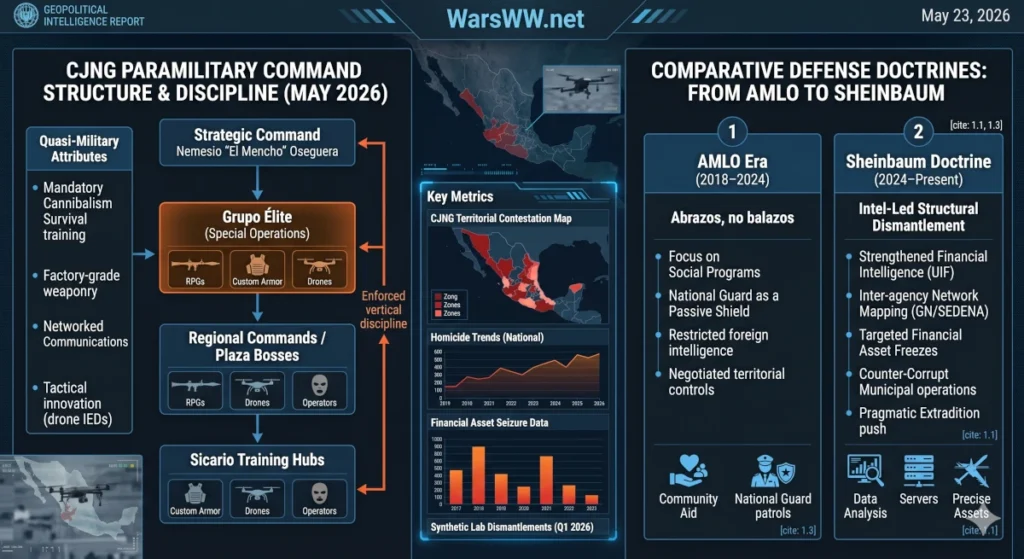
[CJNG PARAMILITARY COMMAND HIERARCHY]

                      [Strategic Command: El Mencho]
                                    │
                                    ▼
                     [Grupo Élite (Special Operations)]
                     • Special forces tactics & execution
                     • Unforgiving internal discipline
                                    │
                                    ▼
                [Regional Command / Sicario Training Hubs]
                • Mandatory cannibalism & survival training
                • Complete vertical integration of legal/illegal rackets
The Special Operations Core: The cartel’s frontline combat capability is spearheaded by the “Grupo Élite,” a dedicated special operations unit equipped with factory-standard military assets. The CJNG routinely deploys factory-grade machine guns, rocket-propelled grenades (RPGs), and custom-fabricated “monstruos” (improvised armored fighting vehicles) that outmatch the firepower of municipal police forces.
The Training Subculture: The CJNG enforces internal cohesion through an unforgiving, ritualized boot camp curriculum. Recruits are placed in isolated training camps where they undergo mandatory survival courses, weapon specialization modules, and acts of forced cannibalism against victims to permanently desensitize the fighters before forward deployment.
Tactical Innovation: The cartel was among the first to pioneer the weaponization of commercial drones, dropping airborne Improvised Explosive Devices (IEDs) directly onto security forces and civilian centers in Michoacán to physically depopulate contested trafficking corridors.
Criminal Governance: The CJNG combines this mailed-fist violence with informal social steering. In its strongholds, it moves beyond illegal rackets into the enforced horizontal licensing of legal goods—including tobacco, alcohol, and basic staples like tortillas—displacing state authority to establish dual sovereignty shared with local populations.
II. The Strategic Evolution: From Obrador’s “Abrazos” to Sheinbaum’s Intel-Driven “System”
President Claudia Sheinbaum’s administration marks a distinct, pragmatic shift in Mexico’s national security architecture, diverging from the foundational doctrine of her predecessor.
1. The Backstory: Bypassing “Abrazos, no balazos”
Former President Andrés Manuel López Obrador’s (AMLO) hallmark strategy, “Abrazos, no balazos” (Hugs, not bullets), prioritized long-term social programming to dry up cartel recruitment pools while deliberately avoiding direct, high-tempo kinetic confrontations with major cartel networks. While AMLO created the militarized National Guard, critics argued his passive posture permitted cartels to deeply solidify their territorial grip and expand their criminal governance.
2. The Sheinbaum Doctrine: Intelligence and Structural Dismantlement
Upon taking office, Sheinbaum pivoted toward an aggressive, data-centric framework. While maintaining the presence of federal forces, her strategy acknowledges that raw military might alone cannot defeat transnational criminal syndicates.
- Targeting the Infrastructure: Force is treated as only one element. The cornerstone of the current doctrine relies on strengthened intelligence operations and targeted financial investigations. The objective is to systematically map, freeze, and dismantle the complex political and financial ecosystems that sustain cartel impunity, targeting corrupt municipal enablers and elite money-laundering hubs.
- The Crackdown Metrics: The results of this intelligence-led push have yielded tangible tactical successes. Under Sheinbaum’s administration, homicides have declined by over 25% alongside the physical dismantlement of more than 1,200 synthetic drug laboratories nationwide.
III. The Transatlantic Leverage: Washington’s Maximum Pressure
Sheinbaum’s strategic shift is unfolding under intense bilateral pressure from the United States, creating a complex diplomatic tightrope.
- The Extradition Valve: To stave off unilateral U.S. economic penalties or direct military interventions threatened by Washington, Sheinbaum has handed over nearly 100 high-ranking cartel figures to face justice in American courts.
- The Party Crisis: This security alliance faces severe domestic strain. The recent voluntary surrender of two top officials from Sinaloa state to U.S. authorities over alleged ties to the Sinaloa Cartel has sparked a political crisis within Sheinbaum’s ruling Morena party, bringing the investigation dangerously close to high-ranking allies of her mentor, AMLO.
- The Sovereignty Abyss: Tensions erupted further following disclosures that unauthorized CIA operations were active on Mexican soil, leading to an official investigation by Mexico’s Attorney General (FGR) after alleged U.S. intelligence assets died during a synthetic mega-lab raid in Chihuahua.
| Security Doctrine Comparison | AMLO Era (2018–2024) | Sheinbaum Doctrine (Present) |
| Primary Philosophy | Abrazos, no balazos (Social Prevention) | Intelligence-led Structural Attrition |
| Tactical Execution | Deployment of the National Guard as a passive shield | Targeted financial, network, and political dismantlement |
| U.S. Cooperation | Restricted DEA/Foreign Agent access | Pragmatic extradition; intense friction over sovereign intelligence |
WarsWW Intelligence Note [REF: MX-CARTEL-0523]
The CJNG’s transformation into a disciplined paramilitary machine proves that traditional policing is obsolete. Sheinbaum’s pivot toward financial and political intelligence is the correct structural play, but it is a race against time. She must dismantle the cartels’ internal financial networks before escalating U.S. legal indictments fracture her political coalition from within, or trigger a unilateral American show of force that would obliterate bilateral security coordination entirely.