
Oreshnik Missile Program RS 26 Mirv Hypersonic Interception
WarsWW Intelligence Spotlight: Decoding the Oreshnik Program—Moscow’s Post-Treaty Blackjack [REF: TECH-ORESHNIK-2026]
Strategic Status: REGIONAL INTERDICTION OVERWATCH / EX-ATMOSPHERIC SATURATION
Threat Vector: Hypersonic Intermediate-Range Ballistic Missile (IRBM)
I. The Backstory: The Transformed ICBM (The RS-26 Architecture)
To understand the technical reality of the Oreshnik (“Hazelnut”), readers must grasp its genetic lineage. The Oreshnik is not an entirely clean-sheet invention. It is an engineered adaptation of the RS-26 Rubezh, a solid-fueled Intercontinental Ballistic Missile (ICBM) program that Russia nominally shelved in 2018 to reallocate funding toward strategic hypersonic glide vehicles.
[THE ARCHITECTURAL SPLIT]
[RS-26 RUBEZH (Legacy ICBM)]     ►     [ORESHNIK (Modern IRBM)]
─────────────────────────────────       ─────────────────────────────────
• 3-Stage Rocket Motor                  • 2-Stage Rocket Motor
• Range: 5,500km - 6,000+ km            • Range: 3,500km - 5,470 km
• Primary Role: Intercontinental        • Primary Role: Theater Saturation
By removing a booster stage from the heavy RS-26 framework, Russian engineers shortened the fuselage, reoriented its software, and scaled down its range from intercontinental parameters to intermediate thresholds (3,500 km to 5,470 km). This design modification structurally shifted the platform out of the ICBM classification and firmly into the Intermediate-Range Ballistic Missile (IRBM) profile.
This shift carries major geopolitical consequences: following the 2019 collapse of the Intermediate-Range Nuclear Forces (INF) Treaty, Russia is now structurally free to mass-produce mobile, road-ready IRBMs designed explicitly to cover the entire European theater from the Russian interior or its deployment nodes in eastern Belarus.
II. Why It Can Bypass Interception: The Kinematic Nightmare
When Vladimir Putin publically proclaims that the Oreshnik is “impossible to intercept,” it is not simple political posturing. The defensive vulnerability stems entirely from the missile’s unique flight profile and specialized multiple-warhead delivery system:
1. The Terminal Speed Floor (Mach 10+)
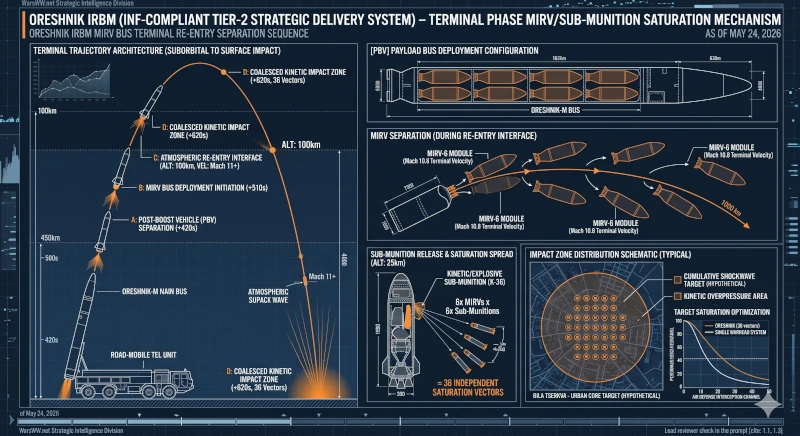
The Oreshnik climbs via a lofted, high-energy trajectory into suborbital near-space. During its terminal re-entry phase, gravity and heavy solid-propellant boosters drive the warhead section down at an overwhelming terminal velocity exceeding Mach 10 to Mach 11 (12,300+ km/h). At these speeds, the time window between initial radar acquisition and ground impact drops to less than 60 seconds, leaving tactical crews virtually zero time to calculate an interception path.
2. MIRV Bus & Sub-Munition Saturation
The core mechanism that renders tactical platforms like the MIM-104 Patriot or NASAMS obsolete is the Oreshnik’s deployment of a Multiple Independently Targetable Reentry Vehicle (MIRV) bus.
- Instead of descending as a singular target, the missile’s upper stage splits in near-space, releasing six independent warhead modules.
- Each of these six warheads subsequently deploys an additional six independent kinetic or explosive sub-munitions.
This cascading deployment means a single Oreshnik launch transforms into 36 hyper-velocity independent targets plunging toward the ground simultaneously. Even if an advanced regional theater battery manages to hit two or three re-entry vehicles, the sheer volume of incoming vectors mathematically saturates and overwhelms the system’s available firing channels.
3. The Interception Vacuum
Current Western defense architectures feature an acute capability gap against this specific profile. Tactical units (Patriot PAC-3, IRIS-T) are optimized to intercept slower cruise vectors or short-range ballistic threats within the lower atmosphere. Conversely, strategic shields (THAAD, Aegis Ashore) are tailored to calculate high-altitude ICBM arcs.
The Oreshnik operates squarely within the mid-tier dead zone. To reliably neutralize an Oreshnik, an air defense network requires heavy, highly specialized exo-atmospheric systems—such as Israel’s Arrow-3 or the U.S. Navy’s SM-3 Block IIA—assets that are entirely absent from the Ukrainian battlefield and strictly limited in Western Europe.
III. The Strategic Message: Conventional Deterrence as an ICBM Alternative
By systematically integrating the Oreshnik into its theater-level strikes against deep Ukrainian rear infrastructure, the Kremlin is sending a calculated strategic message aimed directly at NATO headquarters.
[THE STRATEGIC MESSAGE DECOUPLING]
[THE TRADITIONAL COLD WAR RISK]          [THE ORESHNIK PARADIGM]
───────────────────────────────────     ───────────────────────────────────
• Deep strikes require ICBMs.           • Deep strikes use localized IRBMs.
• Threatens the US mainland.            • Decouples US security guarantees.
• Immediate Strategic Nuclear War.      • "Conventional" Strategic Attrition.
1. Decoupling the Euro-Atlantic Shield
During the Cold War, any weapon capable of multiple-warhead (MIRV) suborbital delivery was explicitly nuclear and intercontinental, meaning its launch would instantly trigger global early-warning networks and invite an immediate American retaliatory response.
By deploying a down-scaled, dual-capable IRBM, Russia proves it can execute strategic, multi-warhead strikes across any capital city in continental Europe within 6 to 8 minutes of launch without threatening the U.S. mainland directly. This creates an agonizing diplomatic wedge: it forces European leaders to consider whether Washington would risk a domestic nuclear exchange to avenge a theater-level conventional strike on Warsaw, Riga, or Berlin.
2. The Concept of “Strategic Non-Nuclear Deterrence”
The most innovative element of the Oreshnik program is its validation of purely kinetic strategic destruction. Because the warheads enter the atmosphere at extreme terminal velocities, their raw kinetic energy creates immense shockwaves capable of crushing deeply buried concrete bunkers, factories, and hardened command centers without needing an explosive payload.
This provides Moscow with a highly potent weapon: a system that inflicts the structural damage of a low-yield tactical nuclear weapon while remaining technically conventional. It allows Russia to threaten catastrophic infrastructure annihilation across the European continent without crossing the nuclear threshold or triggering automated Western nuclear launch doctrines.
WarsWW Intelligence Note [REF: TECH-ORESHNIK-0524]
The Oreshnik is fundamentally a political extortion lever masked as an aerospace asset. The Kremlin understands that it cannot match the combined industrial output of the Western alliance in a conventional, prolonged war of material attrition. The Oreshnik bypasses this deficit entirely. By demonstrating an absolute, mathematically un-interceptable theater weapon, Moscow is signaling to incoming Western leadership that any further expansion of direct military assistance will meet an asymmetric, hypersonic infrastructure response that European air defenses are fundamentally unequipped to stop.