Russian Drone Barrage Ukraine Crimea Train Strike Jun 4, 2026
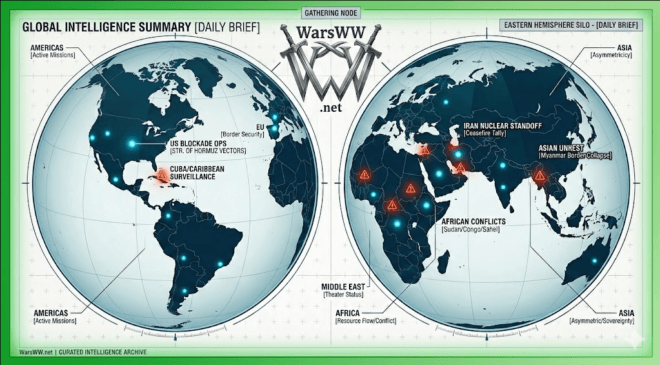
WarsWW Daily Brief | June 4, 2026
Intelligence Status: VECTOR SATURATION CAPABILITY / DIPLOMATIC FRAGMENTATION / LEVANT SECURITY CORRIDOR REJECTION
Global Security Index: 9.98/10 (Critical Systemic Instability)
I. Eastern Europe: The 293-Vector Saturation Surge and Crimea Transport Interdiction
The air war over Ukraine has expanded into a continuous, high-volume saturation matrix testing automated early-warning networks across multiple operational nodes. Concurrently, asymmetric Ukrainian counter-strikes are actively targeting vital logistics links inside occupied territory.
- The 293-Drone Overnight Barrage: Russian Aerospace Forces launched a massive, coordinated overnight air assault deploying a dense mix of an Iskander-M ballistic missile and 293 loitering attack platforms—including Shahed, Gerbera, Italmaz, and Banderol variants alongside Parodiya decoy drones. Ukrainian Air Force command verified that terminal defense grids and mobile fire units successfully neutralized 264 incoming aerial vectors across northern, southern, and eastern sectors. However, surviving assets penetrated terminal tracking envelopes, sparking fires at a five-story residential structure in Pavlohrad and an industrial asset in Boryspil, Kyiv Oblast.
- The Crimea Commuter Rail Strike: Disrupting critical civilian and military transit lanes on the occupied peninsula, a Ukrainian suicide drone successfully struck a moving commuter train in Crimea. Russian-installed Governor Sergei Aksyonov confirmed the dynamic intercept resulted in one civilian fatality and left three others injured, highlighting the severe vulnerability of logistics infrastructure behind the frontline.
- The Svetlyak-Class Warship Intercept: In a separate maritime operation off the Crimean coast, Ukrainian Unmanned Systems Forces executed a precision strike utilizing naval drones. Commander Robert “Madyar” Brovdi reported that Ukrainian drones successfully struck a Russian Svetlyak-class border patrol ship alongside a Pantsir-S1 anti-aircraft missile system in Strilkove, severely compromising Russia’s tactical maritime air defense line.
II. Middle East: The Washington Truce Stagnation and Hezbollah’s Southern Ultimatum
The diplomatic architecture overseen by the White House has encountered severe friction as active frontline proxy networks completely reject the parameters of the provisional Washington framework.
- Hezbollah Rejects the Litani Ceasefire: Despite provisional bilateral agreements reached in Washington between Israel and the Lebanese government, Hezbollah officially rejected the latest ceasefire agreement. Hezbollah Leader Naim Qassem announced via a televised message that demanding their fighters withdraw from southern Lebanon under fire constitutes unconditional surrender. Qassem stated that cross-border rocket and drone strikes against northern Israeli settlements will persist as long as Israeli defense forces occupy sovereign Lebanese territory.
- The UNIFIL Peacekeeper Casualty: The security environment in southern Lebanon deteriorated rapidly following intensive mortar exchanges near Marjayoun. United Nations officials confirmed that one Serbian UNIFIL peacekeeper was killed and two others were wounded when a mortar shell struck their position. Initial U.S. and U.N. intelligence sources indicate the rogue mortar vector originated from an active Hezbollah firing position targeting advancing armor units.
- The Beirut Red Line Warning: Strategic coordination between the U.S. and Iran remains deadlocked. Iranian Foreign Minister Abbas Araghchi explicitly warned that any targeted Israeli airstrike on the Lebanese capital of Beirut will trigger a full-scale resumption of the U.S.-Iran conflict. Concurrently, Israeli Defense Minister Israel Katz announced that the IDF will not withdraw from its forward positions, demanding a permanent demilitarized zone inside southern Lebanon.
III. Western Horizon: The Capitol Hill War Powers Rebuke
Domestic political pressure surrounding the ongoing multi-theater deployment has manifested as an explicit legislative challenge to the executive branch’s military strategy.
- The House War Powers Resolution: Defying executive commander-in-chief authority, the U.S. House of Representatives approved a war powers resolution to halt military action against Iran in a tight 215-208 vote. President Donald Trump immediately condemned the legislative maneuver via social channels, labeling the bipartisan vote unpatriotic and arguing it disrupted high-stakes peace negotiations aimed at permanently reopening the Strait of Hormuz to international commerce.
IV. Featured Visual Intelligence Archive [REF: INTEL-MAP-2026-0604]
Strategic Theater Vectors and Attrition Matrix
| Operational Phase Node | Primary Tactical Asset | Target Vector / Infrastructure | Current Strategic Attrition Status |
| Crimea Peninsula | Low-Altitude Strike UAV | Commuter Rail / Svetlyak Patrol Ship | 1 Dead; patrol ship heavily compromised |
| Boryspil District | Shahed-136 Loitering Variant | Industrial Fuel Facility | Active structural fire; localized grid isolation |
| Marjayoun Sector | High-Velocity Tactical Mortar | UNIFIL Peacekeeper Outpost | 1 Serbian peacekeeper killed; 2 personnel wounded |
| Persian Gulf Corridor | Strait Counter-Measures | Global Crude Supply Core | Brent futures easing at $97.14 per barrel amid truce talks |
Figure 1: Strategic tracking matrix detailing the 293-vector Russian saturation flight corridors over Ukraine alongside targeted maritime strike vectors intersecting the Svetlyak patrol ship off the Crimean coast, June 4, 2026.
V. Indicators to Watch
- [LOGISTICS] The Rail Squeeze Response: Monitor Russian military logistics movements exiting Krasnodar. Following the successful precision drone strike on the Crimean commuter train infrastructure, watch to see if Russia shifts heavy supply lines exclusively to the vulnerable Kerch Bridge or expands overland road transport routes through the occupied southern corridor.
- [DOMESTIC ECONOMY] Labor Market Stagnation: Track U.S. macroeconomic telemetry. Following reports that U.S. weekly jobless claims hit a four-month high of 225,000 due to ongoing economic uncertainty linked to the Persian Gulf maritime disruption, watch for changes in consumer spending indices if fuel prices add further inflationary pressure.
WarsWW Intelligence Note [REF: DAILY-2026-0604]
The contemporary global defense paradigm is experiencing an acute state of Command-Chain Decoupling. While sovereign governments negotiate formal de-escalation frameworks within the State Department, frontline asymmetric actors like Hezbollah maintain the absolute capability to veto diplomatic outcomes via localized kinetic action. This fragmentation is mirrored in the West, where the legislative branch’s passage of an anti-war resolution directly undercuts the executive’s negotiating leverage with Tehran. As a result, formal treaties are losing their structural utility, leaving the global security architecture entirely dictated by real-time attrition rates on the ground.
CISA Warnings
CISA Warns of ATG Cyberattacks + New KEV: CISA and seven partner agencies issued a joint advisory on active compromise of Automatic Tank Gauge systems across Energy, Chemical, Food/Agriculture, and Transportation sectors — unattributed but operationally significant. A new Mirasvit deserialization vulnerability (CVE-2026-45247) was added to the KEV catalog with evidence of active exploitation. [CONFIDENCE: HIGH]