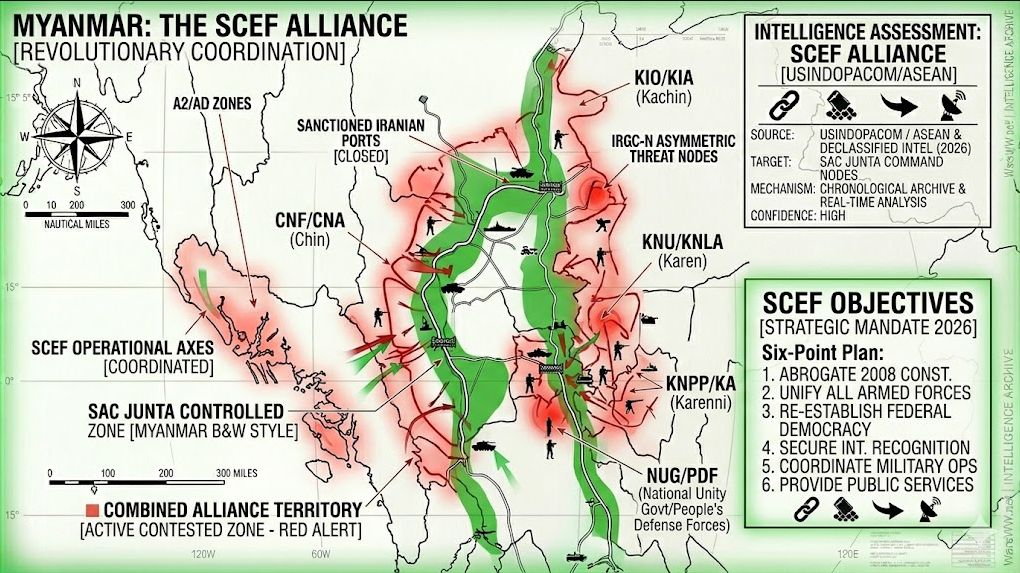
State Administration Council (SAC)—Faces an Unprecedented Challenge to its Survival.
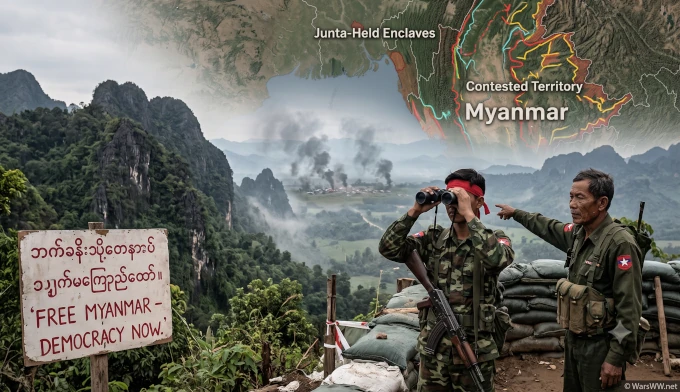
The internal power structure of Myanmar has fractured. More than five years after the 2021 military coup, the ruling military junta—known formally as the State Administration Council (SAC)—faces an unprecedented challenge to its survival.
While predictions of an imminent regime collapse have given way to a more complex, protracted stalemate, the junta has fundamentally lost its ability to project uncontested power across the country. According to analysis from the BTI Transformation Index Country Report, the military’s monopoly over the means of violence is now actively contested across more than two-thirds of Myanmar’s territory.
The Fragile Rebound: A Controlled Consolidation
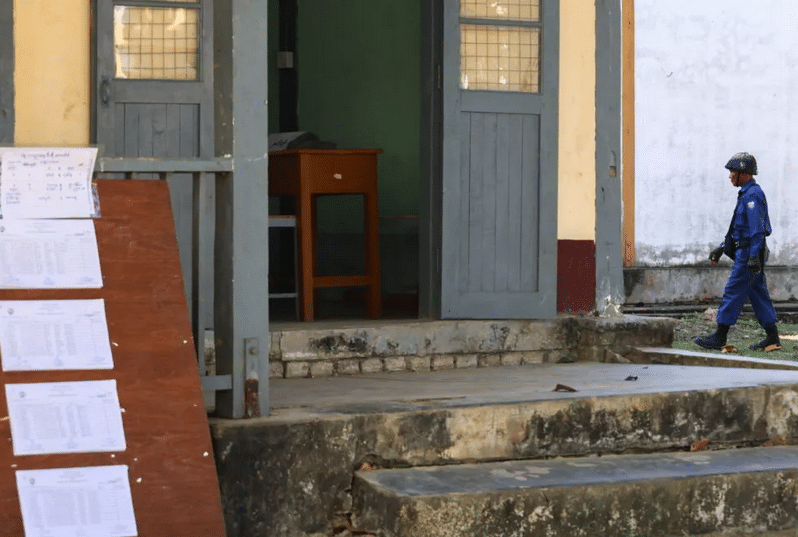
In late 2025 and early 2026, the military junta attempted to project an image of stability by orchestrating tightly controlled sham elections. According to reporting from the International Crisis Group, these elections allowed coup leader Min Aung Hlaing to transition from military commander-in-chief to a nominally civilian president under the framework of the 2008 constitution.
This administrative maneuvering coincided with a brutal, nationwide counter-offensive. Leveraging a highly unpopular forced conscription drive launched in 2024—which feeds roughly 5,000 new recruits into the military machine each month—the junta managed to slow down the sweeping territorial losses it suffered during the resistance’s massive “Operation 1027” campaigns.
Aided by superior airpower, advanced drone tech, and heavy artillery, state media tracked by Burma News International confirmed that the junta successfully recaptured several strategic border towns and urban centers, including:
- Banmauk in the Sagaing Region
- Hpasawng in Karenni State
- Strategic checkpoints like Mawtaung along the Thai border
Yet, as security analysts note at War on the Rocks, these tactical advances do not represent a return to the pre-coup status quo. The junta continues to use scorched-earth tactics, relying almost exclusively on remote firepower rather than ground-level control, effectively ruling the urban centers they reoccupy as isolated fortresses surrounded by a hostile countryside.
Resistance Resilience Amid Growing Fractures
The pro-democracy resistance, anchored by the National Unity Government (NUG) and an array of autonomous Ethnic Armed Organizations (EAOs), still retains control of one-third to one-half of the country. However, the anti-junta coalition faces compounding logistical and political hurdles heading into the second half of 2026.
The greatest challenge facing the resistance is an acute ammunition shortage. The capture and subsequent loss of Falam in April 2026 highlighted a structural weakness: while local People’s Defense Forces (PDFs) are highly motivated, they lack stable heavy-weapons supply chains. Furthermore, War on the Rocks notes that deep-seated, historical distrust between the Bamar-majority NUG and peripheral ethnic factions has often prevented the execution of a singular, synchronized nationwide strategy. Instead, the war is frequently fought as a series of localized, disconnected campaigns.
Despite these coordination gaps, the military has completely failed to pacify its most formidable opponents. In the western periphery, the Arakan Army continues to systematically dismantle junta control, threatening the final government strongholds in Rakhine State, while the Kachin Independence Organisation (KIO) maintains dominant, well-funded positions across the north.
Geopolitical Realpolitik: The China Factor
The shifting frontlines of the Myanmar civil war are heavily dictated by external actors, primarily Beijing. China’s foreign policy in Myanmar is driven entirely by pragmatic stability and infrastructure security.
When regional instability threatened Chinese investments, Beijing brokered temporary, tactical ceasefires with northern border proxies. However, as documented by the Council on Foreign Relations Global Conflict Tracker, China continues to engage heavily with the junta leadership to protect its flagship Belt and Road Initiative projects. In mid-2026, Chinese President Xi Jinping directly urged the junta to advance the China-Myanmar Economic Corridor, a critical pipeline and transport network designed to connect southwestern China directly to the Indian Ocean via Myanmar’s western coast.
Concurrently, regional neighbors like India have maintained diplomatic contact with the newly consolidated administration in Naypyidaw, prioritizing border security and counter-insurgency cooperation over democratic restoration.
The Human Cost: A Region Destabilized
The protracted stalemate has triggered a catastrophic humanitarian emergency that is rapidly spilling over Myanmar’s borders. The U.S. Committee for Refugees and Immigrants (USCRI) reports that the civil war has displaced nearly 4 million people internally, while more than 1.5 million refugees have fled into neighboring Thailand, India, and Bangladesh.
+-----------------------------------------------------------------------+
|                       MYANMAR HUMANITARIAN IMPACT                     |
+---------------------------+-------------------------------------------+
| Internal Displacement     | ~4 Million Civilians                      |
+---------------------------+-------------------------------------------+
| Regional Refugee Outflow  | ~1.5 Million (Thailand, India, Bangladesh)|
+---------------------------+-------------------------------------------+
| Territory Contested/Lost  | Over 66% of the country                   |
+---------------------------+-------------------------------------------+
With the formal economy broken, the junta’s inability to project legitimate governance has turned vast swaths of the country into a breeding ground for transnational organized crime. The collapse of central authority has led to an explosion of industrial-scale cyber-scam operations, illicit narcotics production, human trafficking, and unregulated financial flows that actively threaten the economic security of the entire ASEAN bloc.
Myanmar remains locked in a war of attrition. The military junta possesses the air superiority and conscripted manpower to avoid total collapse, but it lacks the political legitimacy and institutional capacity to ever truly govern the nation again.