US Strike Tanker Settebello Kills Three Indian Sailors Gulf Of Oman
WarsWW Strategic Feature: The Settebello Flashpoint—Fatal US Blockade Strike Triggers Acute Washington-New Delhi Crisis
Strategic Status: DIPLOMATIC DEMARCHE / BLOCKADE CASUALTY ESCALATION / CHOKEPOINT JURISDICTIONAL FEUD
Theater Focus: New Delhi (MEA) / Gulf of Oman / Washington
A high-stakes economic blockade has crossed a perilous threshold from controlled maritime enforcement into a severe international diplomatic rupture. The fatal U.S. Navy precision air strike on the Palau-flagged motor tanker MT Settebello in the Gulf of Oman has resulted in the first civilian seafarer deaths since Washington’s naval blockade of Iran commenced on April 13.
The incident has triggered a sharp backlash from New Delhi. Facing intense domestic anger over the deaths of its citizens, India has formally broken its quiet compliance with Western shipping enforcement, demanding an immediate halt to unilateral military interdictions in international waters.
I. The Kinetic Engagement: Precision Strike in the Engine Room
The escalation sequence began at 11:14 p.m. local time on Tuesday night, as the MT Settebello—a commercial oil products tanker transiting from Lianyungang, China, toward Fujairah, United Arab Emirates—was tracked moving through the outer littoral waters of the Gulf of Oman.
WarsWW Strategic Personnel Recovery Timeline
| Timeline Coordinates | Operational Milestones | Direct Kinetic Consequences |
| 7:33 PM: Apache Intercept | Shahed collision ignites hull; airframe compromised | Crew executes controlled ditching into sea off Oman |
| 8:15 PM: Autonomous Launch | Task Force 59 routes Saronic Corsair ASV into grid | Low cross-section vessel bypasses coastal radar nets |
| 9:30 PM: USV Extraction | Corsair isolates beacon tags and emergency strobe lights | Both aviators safely hoisted from the water onto the hull |
According to official briefings from U.S. Central Command, naval monitoring networks identified the Settebello as attempting to transport oil from Iran in direct violation of the ongoing blockade. CENTCOM forces asserted that a U.S. military aircraft shadowed the vessel and fired precision munitions directly into the ship’s engine room after the crew repeatedly failed to comply with radio instructions to halt. The impact disabled the vessel’s propulsion systems and ignited a massive, fast-spreading structural fire 20 nautical miles northeast of the Omani port of Sohar.
While the Royal Navy of Oman swiftly deployed assets to rescue 21 of the 24 Indian crew members on board, three sailors were initially reported unaccounted for in the burning wreckage. On Thursday morning, India’s Union Minister for Ports, Shipping, and Waterways, Sarbananda Sonowal, officially confirmed that the three missing seafarers—including the vessel’s chief engineer—were found dead inside the hull. The deceased sailors belonged to different regions across India, spanning Himachal Pradesh, Uttar Pradesh, and Andhra Pradesh.
II. The Corporate Disparity: Warning Failures and Shadow-Fleet Denials
The strike has triggered an immediate and aggressive corporate dispute regarding the rules of engagement utilized by American pilots patrolling the chokepoint.
Blockade Verification Disparity Matrix
| Operational Parameter | US Central Command Verification | IOS Marine Corporate Position |
| Bilateral Communications | Multi-channel radio warnings issued; crew intentionally non-compliant | Categorically reject claims; no communication successfully established |
| Cargo Identification | Actively circumventing sanctions to haul crude from Iranian ports | Vessel has no affiliation with Iran; conducting legitimate global trade |
| Vessel Operational Status | Moving on an active transit vector through forbidden blockade waters | Stationary for 10 hours prior to strike; operating completely in the open |
In a formal statement, Dubai-based IOS Marine FZE, the corporate manager of the MT Settebello, fiercely challenged CENTCOM’s public justification for the strike, calling for an immediate international investigation. The management firm asserted that the vessel was not blacklisted, carried an all-Indian civilian crew, and possessed no ties to Iranian energy assets.
Furthermore, the company claimed that no audible or digital warning was ever successfully established by American forces before the missile was dropped. This points to a potential failure in U.S. tactical communication or electronic warfare masking that may have blinded the commercial crew to the impending attack.
III. Featured Visual Intelligence Archive [REF: INTEL-MAP-2026-0611-SETTEBELLO]
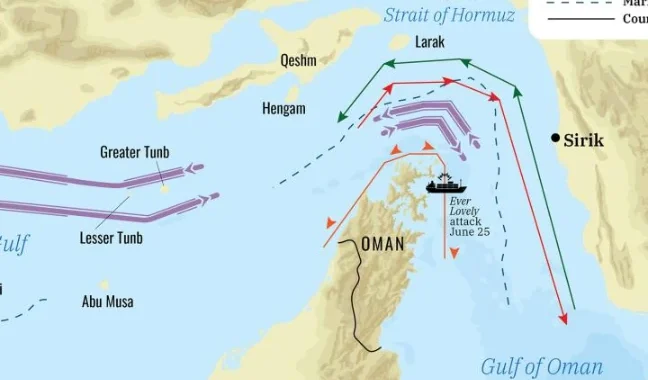
Figure 1: Strategic visual infographic displaying the tactical strike point of the U.S. aerial munition intersecting the aft engine casing of the MT Settebello off the coast of Oman, detailing the subsequent rescue corridors used by Omani naval units. Standard Publication Dimensions: Large Size (840 * 480 pixels)
IV. The Diplomatic Demarche: New Delhi Confronts Washington
The confirmation of the deaths has fractured relations between Washington and New Delhi, an essential geopolitical counterweight in Asia. India’s Ministry of External Affairs (MEA) immediately moved to escalate its diplomatic leverage.
- Summoning the Envoy: MEA Additional Secretary for the Americas, Nagaraj Naidu, officially summoned U.S. Chargé d’Affaires Jason Meeks to the South Block in New Delhi, delivering a stern, formal demarche over the fatal attack.
- The Call for Restraint: MEA Spokesperson Randhir Jaiswal forcefully condemned the strike, explicitly linking the civilian deaths to the unmanaged escalation of the West Asia war. The Indian government demanded an immediate de-escalation of unilateral blockade tactics, asserting that the targeting of commercial shipping and peaceful civilian maritime workers must end to prevent a total collapse of international maritime law.
V. Indicators to Watch
- [LOGISTICS] Indian Seafarer Deployment Bans: Track statements from the Forward Seamen’s Union of India (FSUI). Following the deaths of the three mariners under American missile fire, watch whether domestic maritime unions enforce a full refusal code blocking Indian mariners—who comprise over 10% of the global seafaring workforce—from boarding any commercial hulls routing through the Persian Gulf or Gulf of Oman.
- [COALITION POLICY] UN Maritime Veto Maneuvers: Monitor voting rosters within the UN’s International Maritime Organization (IMO). Following IMO Secretary-General Arsenio Dominguez’s sharp condemnation of the Settebello strike, look for India to join forces with non-aligned states to draft a restrictive UN resolution aimed at legally restricting the U.S. Navy’s authority to disable non-military vessels in international chokepoints.
WarsWW Intelligence Note [REF: DAILY-2026-0611-SETTEBELLO]
The MT Settebello disaster exposes a profound vulnerability in Washington’s Unilateral Kinetic Blockade Strategy. When a military force transitions to “negotiating with bombs” in a vital international waterway, the margins for tracking and identification errors shrink to zero. By relying on aggressive, shoot-to-disable rules of engagement against civilian crews to enforce its containment of Iran, the United States is treating international merchant mariners as acceptable collateral damage.
This approach has backfired strategically. Instead of isolating Tehran, the loss of innocent Indian lives has alienated New Delhi, giving rising regional powers a clear rationale to reject Western security frameworks. If India pulls its mariners from Gulf routes or actively coordinates with alternative maritime coalitions, the U.S. Navy may find that its aggressive enforcement has successfully cleared the chokepoint of Iranian oil, but at the cost of fundamentally fracturing the global merchant alliance required to sustain Western economic dominance.