How the Strait of Hormuz “Toll” Sparked a New Wave of Gulf Strikes
Spotlight: The Fragile Friction
The tenuous seven-week ceasefire between the United States and Iran has fractured dramatically over the last 48 hours. What began as an aggressive economic containment effort in the world’s most critical maritime choke point has rapidly escalated into direct kinetic military strikes, stretching from the drone launch pads of Bandar Abbas to the airspace over Kuwait.
The Catalyst: The “Pay-to-Pass” Regime
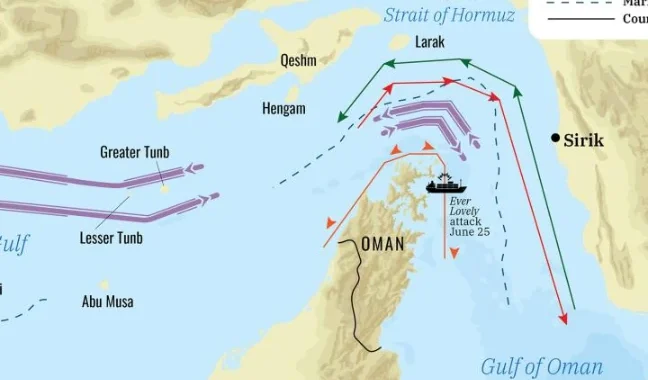
The strategic friction turned kinetic following the formalization of Tehran’s de facto “toll booth” system, overseen by the newly minted Persian Gulf Strait Authority (PGSA).
- The Extortion Scheme: Starved of revenue following prolonged conflict, the IRGC-linked PGSA began mandating full documentation and charging commercial vessels up to $2 million per transit to navigate an Iranian-designated route near its coast.
- The Financial Loophole: To sidestep traditional banking channels, Iran has sought to route these payments through digital assets and stablecoins. Negotiations between Iran and Oman regarding a formalized joint toll and payment framework were reported as recently as May 21.
- The Washington Hammer: On Wednesday, the U.S. Treasury’s Office of Foreign Assets Control (OFAC) took decisive action, formally issuing sweeping counterterrorism sanctions against the Persian Gulf Strait Authority. In tandem, Treasury Secretary Scott Bessent issued a blunt warning, threatening aggressive penalties against Oman if it facilitates the illegal tolling system, noting that the extortion mechanism proves the U.S. economic chokehold has “left the regime desperate for cash.”
The Kinetic Escalation: From Tolls to Drones
The economic standoff translated into raw military action late Wednesday and early Thursday when the U.S. military observed immediate operational threats to shipping lanes.
1.U.S. Intercepts and Preemptive Strikes:Wednesday Night.
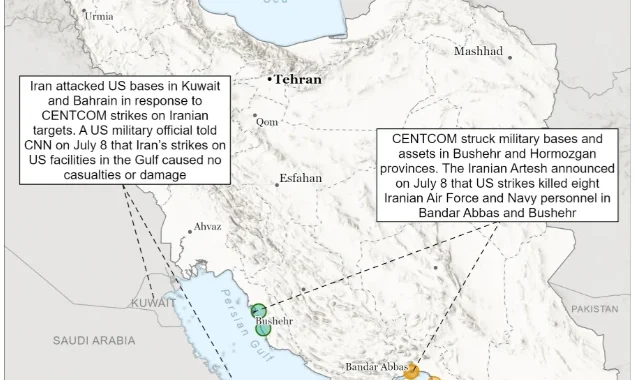
According to official statements, U.S. forces shot down five one-way attack drones operating near the Strait. Concurrently, American assets executed a preemptive strike on an active Iranian ground control station near the Bandar Abbas International Airport just as it prepared to launch a sixth drone.
2.The IRGC Retaliation:Pre-Dawn Thursday.
Acknowledging the explosions in Bandar Abbas via the state-run IRNA news agency, the Islamic Revolutionary Guard Corps (IRGC) launched its own retaliatory strikes against what they claimed was the air base from which the American assault originated.
3.The Airspace Breach over Kuwait:Thursday Morning.
The retaliatory strike crossed international lines, directly drawing in regional allies. U.S. Central Command (CENTCOM) confirmed that a ballistic missile aimed toward Kuwait was successfully intercepted by Kuwaiti air defenses. CENTCOM officially slammed the act as an “egregious ceasefire violation” that actively threatens ongoing diplomatic negotiations to end the war.
The Legal Standoff: Under the United Nations Convention on the Law of the Sea (UNCLOS), the Strait of Hormuz is recognized as an international strait where the right of “transit passage” applies. Iran’s unilateral imposition of a multi-million dollar toll explicitly defies international maritime law, framing their actions not as regulatory maritime management, but as state-sponsored extortion of the global energy supply.
- The Economic Stakes: The Strait carries approximately 20% of the world’s oil supply daily. Shipping conglomerates are caught in an impossible vice: defying Tehran means facing IRGC naval boardings or drone strikes, while paying the toll risks devastating U.S. Treasury sanctions that can instantly freeze global operations.
- The Diplomatic Paradox: Despite the intense trading of blows, both sides are attempting to prevent a return to full-scale hostilities. President Donald Trump noted during a cabinet meeting that negotiations are continuing, asserting that the Iranian regime is currently “negotiating on fumes”.