Linkedin Espionage Recruitment Erfan Shakourzadeh Iran Execution 2026
IRAN EXECUTES AEROSPACE STUDENT ACCUSED OF LINKEDIN SPYING; AI-DRIVEN RECRUITMENT TACTICS ON THE RISE; CODERS WARNED OF ‘WHITE PAPER’ HONEYTRAPS.
Spotlight: The LinkedIn “Little Hook” | Digital Espionage 2026
Intelligence Status: VIRTUAL RECRUITMENT / SOCIAL ENGINEERING
Case Study: Erfan Shakourzadeh (Executed May 11, 2026)
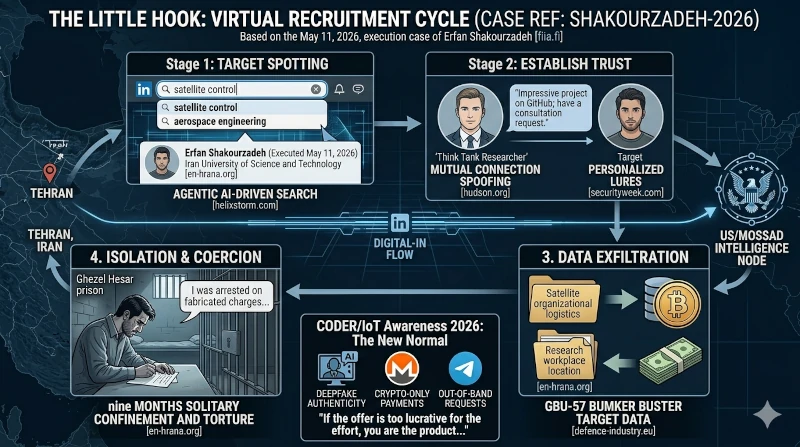
According to the Iranian judiciary’s media outlet, Mizan, Shakourzadeh was targeted through platforms including LinkedIn, WhatsApp, and email en-hrana.org. His case illustrates a “Systemic Attrition” of the scientific community where the primary weapon is a professional connection.
I. The Recruitment Blueprint (The “LinkedIn Trap”)
Adversarial intelligence agencies (linked by Iran to the CIA and Mossad) utilize a specific lifecycle to turn a high-value researcher into a “spy” fiia.fi:
- Target Spotting: Attackers use LinkedIn’s search algorithms to find specific keywords (e.g., “satellite control,” “aerospace engineering,” “IoT security”). Shakourzadeh, a top master’s student at the Iran University of Science and Technology, was a prime “Scientific Asset” timesofisrael.com.
- The “Little Hook”: Recruiters often pose as Headhunters, Think Tank Researchers, or International Scholars. They approach targets with requests that seem professional: “We are writing a paper on satellite constellation positioning; would you be open to providing a technical review for a fee?” realcleardefense.com.
- Escalation via Crypto: In Shakourzadeh’s case, Mizan alleged he was paid in cryptocurrency in exchange for details on his workplace location, ongoing satellite projects, and organizational logistics en-hrana.org.
II. 2026 Awareness: The “AI-Driven” Evolution
For coders and developers, the threat in 2026 has evolved beyond simple fake profiles.
- Hyper-Personalized Lures: Attackers now use Agentic AI to scrape your LinkedIn, GitHub, and Twitter to craft messages that use your specific coding style or project interests as a trust-builder securityweek.com.
- Deepfake Authenticity: “Recruiters” may now use AI-cloned voices or deepfake video calls to conduct “interviews,” making the deception nearly indistinguishable from a legitimate hiring process helixstorm.com.
- The “Visa” Bait: A common tactic used against researchers in high-pressure regimes (like Iran) is the promise of scholarships or visas to study abroad. Shakourzadeh’s forced confession video mentioned that agents tempted him with the idea that there was “no future or progress in Iran” en-hrana.org.
III. Coder/IoT Awareness Factoid: How to Spot the Trap
“If the offer is too lucrative for the effort, you are the product, not the consultant.”
| Red Flag | Description |
| Mutual Connection Spoofing | Attackers connect with your colleagues first to build “Guanxi” (perceived trust) before approaching you hudson.org. |
| Out-of-Band Requests | Quickly moving from LinkedIn to encrypted apps like WhatsApp or Telegram for “confidentiality” en-hrana.org. |
| The “White Paper” Request | Being paid a high fee for a simple “summary” of your current (possibly sensitive) work realcleardefense.com. |
| Crypto-Only Payments | Requests to be paid in Monero or Tether to “avoid international banking fees” en-hrana.org. |
WarsWW Intelligence Note [REF: RECRUIT-LINKEDIN-2026]
The execution of Erfan Shakourzadeh is a reminder that in 2026, Digital Friction has lethal consequences. While he maintained his innocence and claimed his confessions were forced via torture iranwire.com, the methodology described by the state mirrors real-world recruitment patterns used by global intelligence agencies. For the developer community, LinkedIn is no longer just a job board; it is a front-line for human intelligence (HUMINT) operations.