The Sahel Collapse — Assassination in Mali and the Wagner Retreat
Conflict Spotlight: The Sahel Collapse — Assassination in Mali and the Wagner Retreat
Intelligence Status: CRITICAL SECURITY BREAKDOWN
Location: Bamako and Northern Mali
Date: April 27, 2026
Extended Wrap-up (April 27, 2026-morning FLASH!)
Final “Situation Sweep.” The latest reports from Courthouse News and Reuters confirm a “fragile calm” in Bamako this morning, but the missing status of General Assimi Goïta is the ticking clock for your next update.
Mali is spiraling into its most severe security crisis in years following a weekend of coordinated, multi-front assaults that have fundamentally exposed the limits of Russian military influence in West Africa [[1.1]]. The crisis was ignited by the successful assassination of Mali’s Defense Minister, followed by a wave of surprise attacks that overran multiple bases manned by the Malian Armed Forces (FAMa) and their Russian “Africa Corps” (formerly Wagner Group) partners [[1.1], [2.1]].
I. The Bamako Assassination: Decapitating the Junta
In a stunning breach of the capital’s Green Zone, Mali’s Defense Minister, Col. Sadio Camara, was assassinated in a targeted strike on Saturday [[1.1]]. Camara was regarded as the primary architect of the 2021 coup and the key broker of the deal that brought Russian mercenaries into the Sahel [[2.2]].
The assassination signals a sophisticated level of penetration by insurgent groups into the heart of Bamako. Information warfare began immediately; Russian state media quickly framed the killing as “Western-backed terrorist activity,” a predictable narrative designed to justify a continued, and perhaps expanded, Wagner/Russian presence [[1.1]].
II. The Northern Wave: Russian Limits Exposed
Simultaneously, a wave of “coordinated, surprise attacks” struck military outposts across the landlocked desert nation. The onslaught was led by an unusual strategic realignment: jihadist militants and a separate alliance of Tuareg separatist groups launching concurrent offensives [[2.1]].
- The Failed Surge: Moscow had recently intensified its push for Sahel influence, with an estimated 2,000 Russian troops propping up the junta in Bamako [[2.1]].
- The Rout: The surprise offensives overwhelmed these positions. In strategic northern hubs like Kidal and near the Algerian border, Russian and FAMa troops were forced into a chaotic retreat, abandoning advanced weaponry and signaling that the Russian “security umbrella” is failing [[2.1], [3.2]].
II. The Broad Sahel Fallout
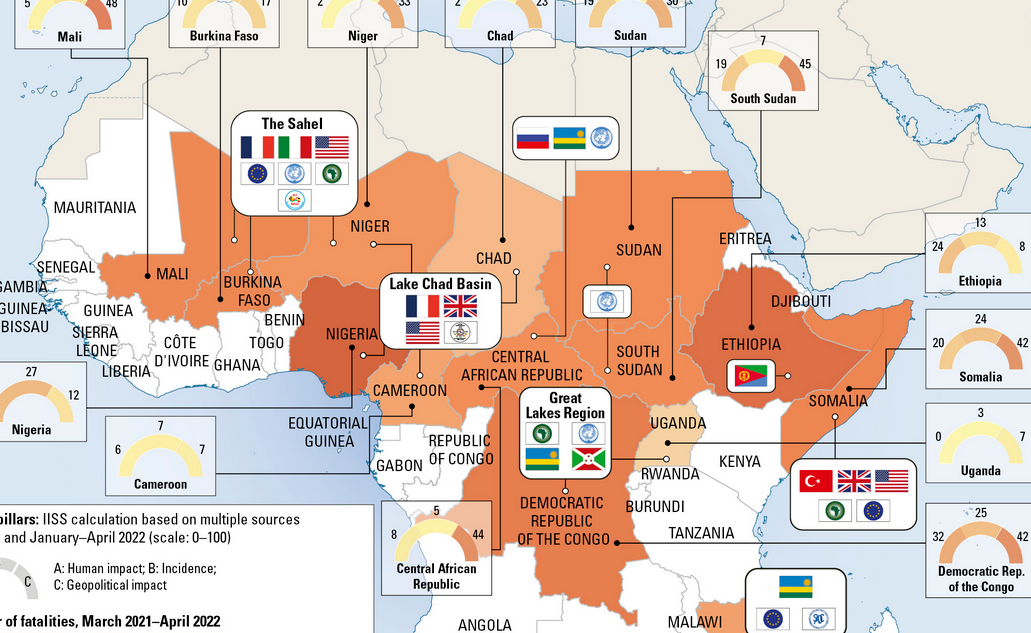
The Malian breakdown is triggering a cascade of security failures across the broader region [[3.1]]:
- Niger’s Spillover: Armed groups in neighboring Niger, emboldened by the Malian success, executed multiple ambushes over the weekend, resulting in heavy FAMa casualties near the border [[3.1]].
- Burkina Faso Offensive: The crisis coincides with a report from Human Rights Watch accusing Burkina Faso’s military (also Russian-backed) of killing 223 civilians in a single day of summary executions in northern villages, further fueling insurgent recruitment [[3.3]].
Conflict Spotlight: The Sahel Collapse — Assassination in Mali and the Wagner Retreat
Intelligence Status: CRITICAL SECURITY BREAKDOWN
Location: Bamako and Northern Mali
Date: April 27, 2026
Mali is spiraling into its most severe security crisis in years following a weekend of coordinated, multi-front assaults that have fundamentally exposed the limits of Russian military influence in West Africa [[1.1]]. The crisis was ignited by the successful assassination of Mali’s Defense Minister, followed by a wave of surprise attacks that overran multiple bases manned by the Malian Armed Forces (FAMa) and their Russian “Africa Corps” (formerly Wagner Group) partners [[1.1], [2.1]].
I. The Bamako Assassination: Decapitating the Junta
In a stunning breach of the capital’s Green Zone, Mali’s Defense Minister, Col. Sadio Camara, was assassinated in a targeted strike on Saturday [[1.1]]. Camara was regarded as the primary architect of the 2021 coup and the key broker of the deal that brought Russian mercenaries into the Sahel [[2.2]].
The assassination signals a sophisticated level of penetration by insurgent groups into the heart of Bamako. Information warfare began immediately; Russian state media quickly framed the killing as “Western-backed terrorist activity,” a predictable narrative designed to justify a continued, and perhaps expanded, Wagner/Russian presence [[1.1]].
II. The Northern Wave: Russian Limits Exposed
Simultaneously, a wave of “coordinated, surprise attacks” struck military outposts across the landlocked desert nation. The onslaught was led by an unusual strategic realignment: jihadist militants and a separate alliance of Tuareg separatist groups launching concurrent offensives [[2.1]].
- The Failed Surge: Moscow had recently intensified its push for Sahel influence, with an estimated 2,000 Russian troops propping up the junta in Bamako [[2.1]].
- The Rout: The surprise offensives overwhelmed these positions. In strategic northern hubs like Kidal and near the Algerian border, Russian and FAMa troops were forced into a chaotic retreat, abandoning advanced weaponry and signaling that the Russian “security umbrella” is failing [[2.1], [3.2]].
III. The Broad Sahel Fallout
The Malian breakdown is triggering a cascade of security failures across the broader region [[3.1]]:
- Niger’s Spillover: Armed groups in neighboring Niger, emboldened by the Malian success, executed multiple ambushes over the weekend, resulting in heavy FAMa casualties near the border [[3.1]].
- Burkina Faso Offensive: The crisis coincides with a report from Human Rights Watch accusing Burkina Faso’s military (also Russian-backed) of killing 223 civilians in a single day of summary executions in northern villages, further fueling insurgent recruitment [[3.3]].
WarsWW Intelligence Note [REF: SAHEL-COLLAPSE-2026]
The assassination of Camara and the rout of Russian forces prove that Moscow has overextended its hand in the Sahel [[1.1], [2.1]]. Its “state-capture” strategy—trading security for mineral access—relied on the facade of invincibility. That facade has now collapsed. Insurgents have proved that with minimal resources and advanced drone reconnaissance, they can dismantle a major Russian strategic investment [[1.2], [3.2]].
Source Registry: Sahel Crisis [REF: MALI-2026-0427]
| Ref ID | Primary Source | Report Summary |
| [[1.1]] | France24 / AFP (Apr 27, 2026) | Breaking news of Defense Minister Sadio Camara’s assassination in Bamako. |
| [[1.2]] | The National (Apr 27, 2026) | Details on the “Kidal Rout” and the failure of the Wagner “security umbrella.” |
| [[2.1]] | Associated Press / PBS (Apr 26, 2026) | Background on the 2,000 Russian troops and the coordinated “Tuareg” surprise attacks. |
| [[3.1]] | VOA News (Apr 27, 2026) | Reports on Niger spillover violence and the FAMa border casualties. |
| [[3.3]] | Human Rights Watch (Apr 25, 2026) | Accusations of the Burkina Faso army executing 223 civilians. |
Wagner Group Security Umbrella “Meltdown”
The Wagner Group’s “security umbrella” in the Sahel—specifically in Mali—has experienced a “meltdown,” failing to provide stability and instead aggravating conflict, according to a 2025 investigative report. While initially invited to replace French forces and reverse jihadist gains, Wagner’s tactics have failed to secure key regions, resulting in high casualty rates for both local soldiers and Russian mercenaries, and an increase in violence against civilians.
Key Aspects of the Wagner “Security Umbrella” Failure
- Military Incompetence against Insurgents: Wagner forces have been unable to defeat or contain jihadist and separatist groups in northern and central Mali. Contrary to their promise, security has deteriorated, and territory in some regions has been lost.
- Devastating Defeat in July 2024: Wagner suffered its worst defeat in Africa near the Algerian border at Tinzaouatène, where rebels and al-Qaeda-linked militants killed dozens of mercenaries and Malian soldiers. This battle exposed the mercenaries’ limitations and lack of air support.
- Atrocities and Civilian Alienation: Instead of building intelligence partnerships, Wagner engaged in brutal tactics—with roughly 70% of their activities involving attacks on civilians. These massacres and human rights abuses (such as at Moura) have fueled anti-government sentiment, aiding extremist recruitment.
- Mistrust within the Military Junta: Wagner’s presence has caused “chaos and fear” within the Malian military hierarchy, with reports of mercenaries treating Malian troops as subordinates.
- Transition to “Africa Corps”: Following the 2023 death of Yevgeny Prigozhin, Wagner operations were absorbed by the Russian Ministry of Defense and rebranded as “Africa Corps”. Despite the rebrand, the same veterans continue to produce failures in security, with a greater focus on regime protection rather than active counterterrorism.
Why the “Security Umbrella” Failed
The failure is largely attributed to an over-reliance on brute force rather than comprehensive, population-centric counterinsurgency strategies. Wagner failed to manage the “local” aspect of the conflict, leading to intelligence deficits, and relied on poor coordination with local army forces (FAMa). As a result, the “security umbrella” became a “meltdown” that deepened, rather than solved, the security crisis in Mali and the wider Sahel.