Syria’s “Justice Net”—IIIM Gains Ground in Damascus
The 14-Year Pursuit of Accountability—New Progress in Syrian War Crimes Prosecutions
April 17, 2026: The “Universal Jurisdiction” Breakthrough
While large news platforms focus on the shifting frontlines, a quieter but profound set of victories is occurring in European courtrooms. This week marks a significant milestone in the use of Universal Jurisdiction, a legal principle that allows national courts to prosecute individuals for international crimes (like torture and crimes against humanity) regardless of where the crimes were committed or the nationality of the victims and perpetrators.
The Intelligence Core: Key Legal Developments
The pursuit of justice for Syria has moved from a stalled UN Security Council to decentralized European accountability mechanisms:
- The Second Wave of French Trials: French investigative judges have recently finalized the indictment of senior Syrian security officials for their roles in the enforced disappearances and deaths of dual nationals. These trials are critical because they target the command level of the security apparatus, rather than just foot soldiers.
- German “Structural Investigations”: German prosecutors continue to use their “structural investigation” model—gathering a massive, centralized archive of evidence from thousands of Syrian witnesses now residing in the EU. This archive is now being shared with neighboring countries, creating a “Justice Net” that makes it increasingly difficult for perpetrators to travel or seek asylum in Europe.
- The Role of Digital Evidence: A major driver of recent progress is the forensic verification of the “Caesar” photographs and millions of leaked internal Syrian government documents. These are no longer just “reports” but are being admitted as primary evidence in criminal trials, directly linking specific officials to documented acts of torture.
The “Hidden” Challenge: Witness Protection and Fatigue | Transnational Repression
For WarsWW.net, we see the underlying story is the immense personal risk taken by the survivors who testify. Many are under active threat from transnational repression units, yet their persistence is what has kept the 14-year legal arc alive when diplomatic efforts failed.
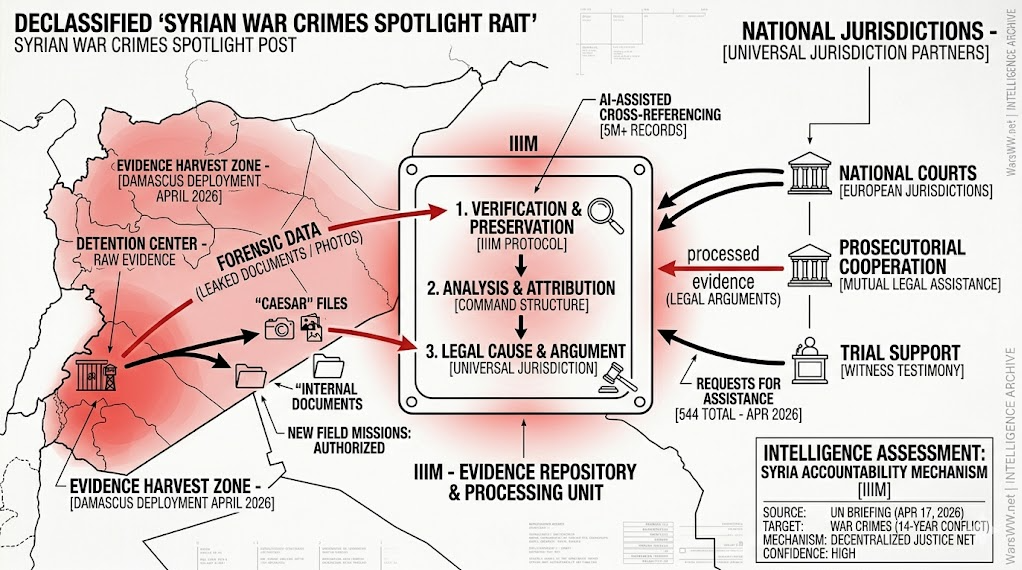
The Intelligence Brief: Concurrent with the diamond debate, ASG Robert Petit (Head of the IIIM) provided a landmark update on the 14-year pursuit of Syrian war crimes accountability.
- Damascus Field Presence: In a significant shift from the Assad era, the IIIM has conducted “near-monthly missions” to Damascus throughout early 2026. The Mechanism has finally received authorization to deploy a dedicated evidence officer inside the Syrian capital.
- The “Justice Net”: As of January 31, 2026, the IIIM has processed 544 requests for assistance from 17 national jurisdictions (including France, Germany, and Sweden), a record high for universal jurisdiction cases.
- The National Commission: Syria has established a National Commission for Transitional Justice, though Petit warned that justice must not be “selective” or recognize only the suffering of specific groups.
Sources. GA/12757
“The Cost of Courage”
The ‘Hidden’ Challenge: Transnational Repression & Witness Fatigue
The April 2026 UN briefing highlighted a sobering reality: as the number of universal jurisdiction cases hits a record high (544 requests), the pressure on the Syrian diaspora has intensified.
The Protection Gap: While the IIIM preserves evidence, it lacks a formal mandate for witness protection. This leaves survivors dependent on the varying domestic laws of host nations, creating a “lottery of safety” for those who risk everything to name their tormentors.
Transnational Repression: Survivors living in Europe face “digital and physical reach-back” from remnant security networks. Witnesses have reported receiving anonymous threats against family members still inside Syria shortly after testifying in European courts.
Witness Fatigue: Many survivors are being asked to recount their trauma across multiple jurisdictions (e.g., testifying in Germany, then France, then Sweden for related cases). ASG Robert Petit noted that justice must not become an “extractive process” that exhausts the very people it seeks to serve.
Connected Reads: